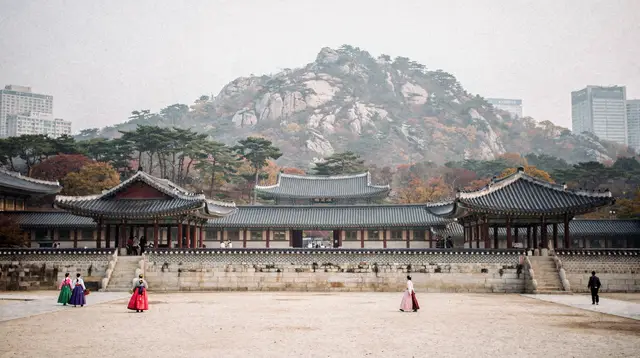
Seoul palace closure days and Culture Day explained
Do all of Seoul's palaces close on the same day?
No. Gyeongbokgung is closed every Tuesday, but Changdeokgung, Deoksugung, Changgyeonggung, and Gyeonghuigung are each closed on Mondays instead. If a closure day lands on a public holiday, most palaces shift the closure to the next non-holiday weekday. The last Wednesday of every month is Culture Day, when all five are free to enter for everyone.
| Closed Tuesday | Gyeongbokgung only |
| Closed Monday | Changdeokgung, Deoksugung, Changgyeonggung, Gyeonghuigung |
| Free entry | Last Wednesday of the month (Culture Day), or wearing a full hanbok |
| Admission | A few thousand KRW per site; Gyeonghuigung free daily |
| Best days for multi-palace visits | Wednesday-Sunday, all five open |
Here’s the mistake almost every first-time visitor makes: they learn that Gyeongbokgung is closed on Tuesdays, assume that rule applies to every royal palace in Seoul, and then show up at Changdeokgung on a Tuesday only to find it wide open — or worse, plan a Monday palace-hopping day around the “safe” assumption that Tuesday is the only day to avoid, and get shut out of four palaces at once. The closure schedule across Seoul’s five royal palaces is not uniform, and getting it wrong wastes a half-day you probably don’t have to spare.
The short version
Of Seoul’s five royal palaces, Gyeongbokgung is the only one closed on Tuesdays. The other four — Changdeokgung, Deoksugung, Changgyeonggung, and Gyeonghuigung — are all closed on Mondays instead. That’s a genuinely useful fact for planning: if you’re building a multi-palace day, Tuesday is actually a fine day to visit any palace except Gyeongbokgung, and Monday is the one day to avoid palace-hopping almost entirely, since four of the five are shut.
This runs opposite to what most travelers assume, because Gyeongbokgung is the palace everyone researches first (it’s the largest, most photographed, and the default first stop), so its Tuesday closure gets generalized as “the” palace closure day across blogs and forum posts that never checked the other four individually.
Palace-by-palace closure days
Gyeongbokgung Palace — closed every Tuesday. This is the palace most visitors plan around, and it’s worth building your whole Jongno day (Bukchon, Insadong, the palace itself) around checking this first. See the Gyeongbokgung vs Changdeokgung vs Deoksugung comparison for how this affects a multi-palace day.
Changdeokgung Palace — closed every Monday, including the Secret Garden (Huwon) guided tours, which run on the same schedule as general admission and don’t operate on the palace’s closure day either.
Deoksugung Palace — closed every Monday. Since Deoksugung sits right next to City Hall and is often paired with a Myeongdong shopping day, checking this against your Myeongdong plans matters if Monday is your only free downtown day.
Changgyeonggung Palace — closed every Monday. This palace also runs night openings during parts of the year, which follow a separate schedule from daytime admission — worth checking directly if an evening visit is part of your plan.
Gyeonghuigung Palace — closed every Monday. This is the smallest and least-visited of the five, free to enter for everyone regardless of hanbok or Culture Day status, and a reasonable stop if you’re already near Seodaemun or the Seoul Museum of History next door.
The pattern to remember: four palaces close Monday, one (Gyeongbokgung) closes Tuesday. If your trip only allows one non-negotiable palace day, Wednesday through Sunday works for all five; Monday rules out everything except Gyeongbokgung; Tuesday rules out only Gyeongbokgung.
Why the closure days differ in the first place
It’s a fair question: why isn’t there just one citywide “palace day off” the way some cities standardize museum closures? Part of the answer is administrative history — the five palaces aren’t managed as a single unit the way, say, a national museum network might be.
Gyeongbokgung, as the flagship site and the most heavily visited, has long operated on its own maintenance and staffing schedule, while the other four, historically grouped together administratively, share a common Monday closure that lines up with typical staff rotation patterns used across many of Korea’s other cultural heritage sites and museums nationwide (a number of national museums also default to Monday closures, for what it’s worth, which is part of why Monday is worth avoiding for a heritage-heavy day generally, not just for palaces).
None of this is something a visitor needs to memorize — the practical takeaway is simply that Gyeongbokgung breaks the pattern the other four follow, and that’s the one exception worth committing to memory.
A sample week, mapped out
If you’re building a multi-day Seoul itinerary and want to see exactly how the closures fall across a normal week, here’s the pattern in full: Monday — only Gyeongbokgung is open; the other four are shut. Tuesday — only Gyeongbokgung is closed; Changdeokgung, Deoksugung, Changgyeonggung, and Gyeonghuigung are all open. Wednesday through Sunday — all five palaces operate normally, with the added bonus that if the trip includes the last Wednesday of the month, that day is also Culture Day. Laid out this way, the actual planning rule simplifies to: never schedule Gyeongbokgung for a Tuesday, never schedule any of the other four for a Monday, and treat Wednesday through Sunday as flexible for any combination.
Admission costs and why the closure schedule matters more than it seems
Individual palace admission in Korea runs cheap by international standards — a few thousand won per site for most of the five, with Gyeonghuigung free every day it’s open. On pure ticket cost, showing up on the wrong day and getting turned away isn’t a financial disaster. What it actually costs is something harder to get back: a chunk of a travel day that doesn’t come around again.
A Tuesday spent walking up to a locked Gyeongbokgung gate, or a Monday spent finding Changdeokgung shut, means scrambling for a backup plan on the spot, in a city you may not know well yet, often with a packed itinerary the rest of the week that leaves no slack to simply try again the next day. That’s the real reason this schedule is worth checking before you finalize dates rather than after you land.
Night openings and special exceptions
Several palaces run limited-capacity night opening events during parts of the year — Gyeongbokgung, Changdeokgung, and Changgyeonggung have all hosted evening illumination programs at various points, letting visitors walk the grounds after dark with the buildings lit.
These run on their own separate ticketed schedule, generally requiring advance booking given limited nightly capacity, and are not simply an extension of normal daytime hours — a palace’s regular weekly closure day doesn’t automatically tell you whether a night program is running that same week, so check the specific event’s own calendar if an evening visit is the goal. These programs aren’t offered year-round, so don’t build a trip around one without confirming it’s actually running during your travel dates.
What happens when a closure day falls on a public holiday
Several of these palaces — Gyeongbokgung, Changdeokgung, and Changgyeonggung among them — shift their closure to the next non-holiday weekday if the regular closure day happens to fall on a public holiday, so the palace stays open on the holiday itself and closes the day after instead. This is a genuinely useful exception, but it’s not something to assume blindly for every palace or every holiday: confirm the specific date against the palace’s own posted schedule if your visit lands near a Korean public holiday (Seollal, Chuseok, and similar), since exceptions and makeup-closure rules can shift year to year.
Culture Day: free entry, last Wednesday of the month
The last Wednesday of every month is Culture Day, when all five royal palaces waive admission for every visitor — no hanbok required, no age restriction, nothing to book in advance. It’s part of a broader push to get free or discounted entry to a range of cultural sites on the same date, not just the palaces, so if you’re building a cultural-heritage-heavy day around this date, it’s worth checking what else near your route participates.
The trade-off is obvious: free entry draws noticeably larger crowds than a normal weekday, particularly at Gyeongbokgung. If your priority is a quiet, unhurried visit rather than saving on admission (which, for most palaces, only runs a few thousand won anyway), a normal weekday outside Culture Day is the better call. If budget matters more than crowd levels, or if you’re specifically trying to see multiple palaces in one day without paying admission at each, Culture Day is worth building a date around.
How this interacts with the hanbok free-entry rule
Separately from Culture Day, wearing a complete hanbok — top and bottom both — gets free entry to all five palaces on any non-Culture-Day date too, as covered in hanbok rental and free palace entry. The two discounts don’t stack in any meaningful way since Culture Day is already free for everyone, but if your visit doesn’t land on the last Wednesday of the month, hanbok rental is the next-best way to skip admission while also getting photos out of the visit.
Hanbok rental with free Gyeongbokgung entry includedCombining a palace day with a guide who already knows the schedule
If juggling five different closure days across a short trip feels like more logistics than you want to manage, a guided palace day sidesteps the whole calculation — the itinerary is already built around whichever palaces are open on your specific date, and a guide typically layers in context (dynastic history, architectural details) that’s easy to miss reading signage alone.
Gyeongbokgung, Folk Museum, Bukchon and Jogyesa guided tourBuilding a multi-palace day around the schedule
If you want to see two or more palaces in a single day, the practical rule is simple: avoid Mondays entirely (four of five are shut), and if Gyeongbokgung is one of your targets, avoid Tuesdays too. Wednesday through Sunday, all five palaces operate on their normal schedule, which means the actual constraint on a multi-palace day becomes geography and opening hours rather than closures.
Gyeongbokgung and Changdeokgung, a 15-20 minute walk apart via Bukchon Hanok Village, pair well for a single day. Deoksugung sits further south near City Hall and works better as its own half-day, ideally combined with Myeongdong rather than squeezed in after two other palaces. Changgyeonggung and Gyeonghuigung are smaller and best treated as add-ons if you’re already in their immediate neighborhood — Changgyeonggung borders Changdeokgung directly, and Gyeonghuigung sits near Seodaemun, a short walk from Gwanghwamun.
Seasonal opening hours also change
Beyond weekly closures, most palaces run seasonal hour adjustments — shorter daylight hours in winter mean earlier closing times (often by an hour or more compared to summer), and last admission is typically an hour before the posted closing time. This matters most for late-afternoon visits: showing up at what looks like a reasonable hour in December can mean you’re turned away at the ticket gate because last admission already passed. Check the specific palace’s current seasonal hours before planning an afternoon or evening visit, especially outside the June-to-August stretch when hours run longest.
Common mistakes to avoid
Assuming all palaces share Gyeongbokgung’s Tuesday closure. This is the single most common error, and it’s the reason this guide exists — four of the five palaces are closed Monday, not Tuesday.
Planning a Monday multi-palace day. Monday is the worst possible day for palace-hopping in Seoul, since only Gyeongbokgung operates. If Monday is your only available day, build it around Gyeongbokgung, Bukchon, and Insadong instead, and save the other palaces for a different day.
Not checking the Secret Garden’s schedule separately. Changdeokgung’s Huwon guided tours follow the same weekly closure as the main palace, but they also have their own daily time slots and capacity limits — a palace being open doesn’t guarantee a Secret Garden slot is available same-day, especially on weekends.
Assuming Culture Day means no crowds. Free entry pulls more visitors, not fewer. If a quiet visit matters more to you than the admission fee, pick a regular weekday instead.
Where this fits in a longer Seoul trip
If you’re deciding which palaces are worth the closure-day planning in the first place, Gyeongbokgung vs Changdeokgung vs Deoksugung breaks down what each one actually offers. For the free-entry hanbok mechanics, see hanbok rental and free palace entry. If you’re building your route around Gyeongbokgung and Jongno or Bukchon and Insadong, factor the closure day into which day you assign to that neighborhood.
For getting between palaces reliably, the Seoul metro and T-money guide and why Google Maps doesn’t work in Korea cover the transit basics. If you’re mapping this against a full itinerary, the Seoul 3-day itinerary and the 5-day version both show where a palace day typically lands relative to everything else.
Traveling with children changes the calculus too — see Seoul with kids for realistic pacing. And if timing your trip around cherry blossoms or autumn foliage is part of the plan, check the Seoul cherry blossom guide or the Seoul autumn foliage guide alongside this closure schedule, since peak bloom weekends are also when palace crowds run highest.
Frequently asked questions about Seoul palace closure days
Is Gyeongbokgung really the only palace closed on Tuesday?
Yes. Among the five royal palaces, Gyeongbokgung is the sole Tuesday closure. Changdeokgung, Deoksugung, Changgyeonggung, and Gyeonghuigung are all closed on Mondays instead.
What if I can only visit Seoul’s palaces on a Monday?
Plan around Gyeongbokgung, which is the only one of the five open on Mondays. Pair it with Bukchon Hanok Village and Insadong, both of which have no closure day, for a full day that doesn’t depend on the other four palaces being open.
Does the Changdeokgung Secret Garden have its own closure day?
It follows the same Monday closure as the main Changdeokgung palace grounds, but it also runs on a separate timed-tour schedule with limited daily capacity, so check availability for your specific date rather than assuming a slot is open just because the palace itself is.
What exactly happens on Culture Day?
On the last Wednesday of every month, all five royal palaces waive their admission fee for every visitor, with no hanbok or age requirement. Several other cultural sites in Seoul participate on the same date, though not automatically every museum or heritage site in the city.
Does wearing a hanbok still get me free entry if it’s not Culture Day?
Yes — a complete hanbok (top and bottom) gets free entry to all five palaces on any date, independent of Culture Day. See hanbok rental and free palace entry for the specific rules on what counts as “complete.”
Do closure days change if a holiday falls on them?
Several palaces, including Gyeongbokgung and Changdeokgung, shift the closure to the next non-holiday weekday if the usual closure day coincides with a public holiday, so the palace stays open through the holiday itself. Confirm the exact date against the palace’s posted schedule if your trip lands near a Korean public holiday.
Are seasonal hours different from the weekly closure schedule?
Yes, these are two separate things. The weekly closure (Monday or Tuesday depending on the palace) determines which days the palace is open at all; seasonal hours determine what time it opens and closes on the days it is open, with shorter hours in winter and longer hours in summer.
Which palace is least affected by closure-day confusion?
Gyeonghuigung, since it’s free every day regardless of hanbok or Culture Day status — the only closure to plan around is its regular Monday shutdown.
Palace & heritage tours on GetYourGuide
Verified deep-linked GetYourGuide tours. Book through these links and we earn a small commission at no cost to you.
GetYourGuide does not provide product photos: on its activity cards, the picture illustrates the type of experience and is not the operator's own photo.
Seoul: Half-Day City Highlights & Palace Tour with Hanbok

Seoul City Sightseeing Tour Including Gyeongbokgung Palace, N Seoul Tower, and Namsangol Hanok Village