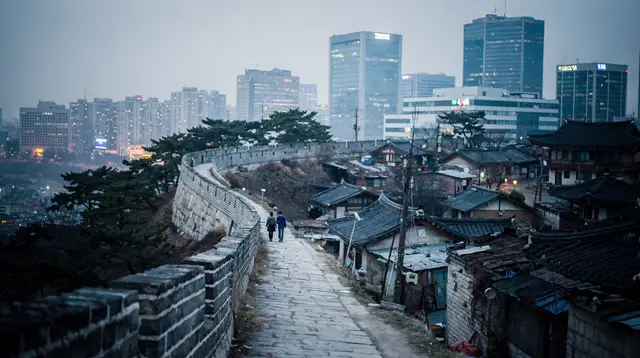
Bukchon Hanok Village and Insadong get folded into most itineraries as an afterthought to Gyeongbokgung Palace, and that undersells both. Bukchon is one of the last intact traditional residential neighborhoods left in central Seoul, and Insadong is the city’s most reliable street for actual Korean crafts rather than mass-produced souvenirs. This guide treats them as their own half-day destination, with the timing and etiquette details that separate a good visit from a crowded, rushed one.
| Where | Jongno-gu, between Gyeongbokgung and Changdeokgung |
| Cost | Free to walk; tea houses and souvenirs extra |
| Time needed | Half day (3-4 hours); full day with Gwangjang Market |
| Getting there | Anguk Station, Line 3, exit 2 |
| Best time | Before 9am or after 5pm for Bukchon; any time for Insadong (Sundays busiest, pedestrian-only) |
Bukchon Hanok Village: a residential neighborhood, not a museum
Bukchon sits on the low hills between Gyeongbokgung and Changdeokgung Palace, and the crucial thing to understand before you go is that people actually live in these hanok houses — this isn’t a preserved historical district maintained purely for visitors, it’s a functioning residential neighborhood that happens to have several hundred years of continuous traditional architecture. That distinction matters for how you behave here: no peering into windows, no blocking narrow lanes for photos when residents are trying to get past, and lowered voices, especially early morning and evening when people are commuting or settling in for the night.
Anguk Station (Line 3, exit 2) is the closest subway stop, putting you a 5-10 minute walk from the neighborhood’s main viewpoints. The single most photographed spot — a steep, narrow alley called Bukchon-ro 11-gil — offers the classic shot of hanok roof tiles cascading downhill with Namsan or the modern skyline in the distance, depending on the angle. It’s genuinely worth seeing, and genuinely crowded by mid-morning on any day with decent weather.
The honest timing advice: arrive before 9am if photography without a crowd of other visitors’ phones in frame is the goal. After 5pm works too, with softer light and thinning crowds, though you lose some daylight for photos depending on season. Midday, especially on weekends, this alley is packed enough that getting a clean shot takes real patience.
Beyond the famous alley, Bukchon rewards slower wandering. The streets one or two blocks over from Bukchon-ro 11-gil have similar architecture with a fraction of the foot traffic — small galleries occupying converted hanoks, a scattering of traditional tea houses, and the occasional artisan workshop for pottery or textiles. The Bukchon Traditional Culture Center, a free facility near the neighborhood’s center, offers context on hanok construction and occasionally hosts craft demonstrations, a useful stop if you want more than just the visual experience.
Insadong: Seoul’s actual crafts street
A 10-15 minute walk southeast from Bukchon (or accessible directly via Anguk Station), Insadong-gil is the main pedestrian shopping street, closed entirely to vehicle traffic on Sundays and partially restricted the rest of the week. This is where Seoul concentrates its genuine craft retail — calligraphy brushes and ink stones, hanji (traditional mulberry paper) stationery and lampshades, celadon and buncheong pottery, and traditional tea sold by weight rather than in prepackaged tourist tins.
It is, without question, a touristy street — that’s been true for decades, and the crowds and English-language shop signs reflect it. But unlike a lot of souvenir strips elsewhere in Asia, the goods sold here are mostly real crafts made by real artisans, some of whom you can watch working in smaller shops off the main drag. The distinction between Insadong and a generic tourist market is worth knowing before you write it off as too commercial to bother with.
Ssamziegil, a spiral-ramp shopping building just off the main street, organizes several floors of small independent design studios and craft shops around a central open atrium — worth the walk-through even without a shopping list, mostly for the building’s layout, which encourages a slow loop rather than a straight in-and-out.
Tea houses tucked into converted hanoks a block or two off the main street are a legitimate way to rest mid-afternoon. Expect to pay more than a standard café — the setting, the traditional serving style, and often a small side of rice cakes or cookies are part of what you’re paying for, not just the tea itself.
Jogyesa Temple: five minutes from Insadong’s north end
Jogyesa Temple, headquarters of the Jogye Order of Korean Buddhism, sits a short walk north of Insadong’s main street and is free to enter. Unlike some temple attractions that feel curated for visitors, Jogyesa is an active place of worship — you’ll see monks and lay Buddhists going about genuine religious practice on any given day, which is worth keeping in mind: quiet voices, no flash photography during ceremonies, and general respect for the space’s actual function over its role as a photo stop.
The temple grounds are compact but include two large, centuries-old trees (a white pine and a Chinese scholar tree) that predate the current temple buildings, plus vivid, elaborately painted eaves typical of Korean Buddhist temple architecture.
Gwangjang Market: the natural extension
Insadong sits within easy walking distance (or one subway stop) of Gwangjang Market, widely regarded as Seoul’s best food market and one of its oldest, dating to 1905. If Bukchon and Insadong cover the neighborhood’s history and crafts, Gwangjang covers the food — bindaetteok (mung bean pancakes), mayak gimbap (“addictive” bite-sized gimbap), and a dense concentration of stalls that have fed the same regular customers for generations. It’s genuinely worth extending a Bukchon-Insadong half day into a full one to include it.
A few tour options bridge all three areas in a single guided route, useful if you’d rather not self-navigate the connections between them:
Seoul layover tour: highlights with ICN airport pickup Gwangjang Market street food tasting walking tour Gyeongbok Palace, Bukchon Village, and Gwangjang Market tourFor a deeper, standalone dive into the market itself rather than just a passing mention here, see the Gwangjang Market food tour guide.
Etiquette specifics worth knowing before you go
Bukchon’s residents have, at points, posted multilingual signs asking visitors to keep noise down and avoid blocking doorways — a direct response to years of tour groups treating the neighborhood purely as a backdrop. The unofficial local guidance that’s emerged: stick to the marked walking routes rather than wandering into every side alley, don’t photograph residents or their open front doors without asking, and accept that some of the neighborhood’s most photogenic corners are simply someone’s front step, not a public installation.
Insadong, being a purely commercial street, has none of these sensitivities — it’s built for foot traffic and photography. The etiquette that matters more there is standard market politeness: don’t handle pottery or ceramics you don’t intend to buy, and ask before photographing individual artisans at work in smaller shops.
Why this neighborhood survived when so much of old Seoul didn’t
Central Seoul lost the overwhelming majority of its traditional hanok housing stock across the 20th century — colonial-era demolition, wartime destruction during the Korean War, and decades of rapid postwar redevelopment all took a toll, and by the 1980s Bukchon itself was under real threat of being cleared for modern apartment blocks like most of the rest of the city.
A series of preservation policies from the late 1990s and 2000s, driven partly by resident advocacy and partly by the city government recognizing the neighborhood’s cultural value, protected Bukchon’s remaining hanok stock and funded restoration of buildings that had fallen into disrepair. That history is worth knowing while walking the alleys: what looks like an unbroken traditional streetscape is actually the result of a fairly recent and deliberate rescue effort, not an untouched survival from centuries past.
What isn’t worth the detour
A handful of shops along Insadong’s most tourist-facing stretch sell mass-produced items indistinguishable from what you’d find at any airport souvenir counter, mixed in among the genuine craft retailers — the giveaway is usually identical stock across multiple neighboring shops, a sign of wholesale imports rather than local production. And some of Bukchon’s most-photographed corners have, in peak season, become genuinely difficult to shoot cleanly no matter the hour, simply from sheer visitor volume — worth adjusting expectations rather than fighting the crowd for the exact same shot everyone else is taking.
A realistic budget for the half day
This is one of the more affordable half days in this guide, since walking Bukchon’s alleys and browsing Insadong’s shops costs nothing beyond whatever you choose to buy. Budget for a tea house stop (8,000-15,000 KRW, often including a small snack) and a modest souvenir or two from Insadong’s craft shops, where hanji paper goods and small ceramics start affordably and climb quickly for larger or more elaborate pieces. Add Jogyesa Temple (free) and a Gwangjang Market meal (10,000-20,000 KRW for a generous spread of street food) and a full, well-rounded day runs comfortably under most mid-range daily budgets. See the Seoul budget guide for broader context.
Seasonal notes
Bukchon’s hanok rooftops photograph particularly well against a blue autumn sky (October-November) or, less predictably, a light dusting of winter snow — both are popular windows for photographers specifically. Spring brings cherry and plum blossoms to some of the neighborhood’s side streets, though Bukchon isn’t a dedicated blossom destination the way Yeouido or Seokchon Lake are; see the Seoul cherry blossom guide for the city’s best dedicated viewing spots. Summer’s jangma rains and heat make the uphill sections of Bukchon considerably less comfortable to walk — an argument for tackling this half day in the cooler morning hours if your trip falls in July or August.
Getting there and around
Anguk Station (Line 3, exit 2) is the single best access point for both Bukchon and Insadong, putting you within a short walk of each. Jonggak Station (Line 1) works as an alternative for Insadong’s southern end. As throughout Seoul, use Naver Map or KakaoMap for walking directions through Bukchon’s narrow, winding alleys — see why Google Maps doesn’t work in Korea for why this matters more here than it might elsewhere.
How this fits into a longer trip
Bukchon and Insadong are most commonly paired with Gyeongbokgung Palace as a single Jongno-gu day, and this page exists as the deeper dive for travelers who want to spend real time in the hanok neighborhood and shopping street rather than rushing through both on the way from the palace to lunch. If palace-closure scheduling affects your dates, palace closure days and Culture Day is worth checking — Gyeongbokgung’s Tuesday closure is a good reason to shift a Bukchon-Insadong visit to that specific day instead, since neither depends on the palace being open.
For itinerary context, the Seoul 3-day itinerary and 5-day itinerary both build a Jongno day around this cluster, and seoul neighborhoods explained covers how Jongno-gu’s various -dong subdivisions (Gahoe-dong, Samcheong-dong, Insa-dong) relate to each other for anyone trying to make sense of Korean addresses here.
Bukchon vs Insadong: which one deserves more of your time
Travelers with only an hour or two often ask which of the two to prioritize. The honest answer depends on what you’re after — architecture and quiet wandering, or shopping and craft-browsing:
| Bukchon Hanok Village | Insadong | |
|---|---|---|
| Best for | Photography, architecture, quiet mornings | Shopping, crafts, tea houses |
| Cost | Free (street access only) | Free to browse; shops vary |
| Crowd pattern | Worst mid-morning to afternoon | Worst Sundays (pedestrian-only) |
| Time needed | 1-1.5 hours for the main alleys | 1.5-2 hours to browse properly |
| Accessibility | Steep, uneven hillside lanes | Mostly flat, easier walking |
If forced to choose one, photographers and early risers should lean toward Bukchon; anyone shopping for real souvenirs or gifts should weight time toward Insadong instead. Most visitors do both back to back since they’re a short walk apart, which is the approach this guide assumes.
Samcheong-dong: the café street between the two
Running along Bukchon’s western edge, Samcheong-dong-gil is a tree-lined street of small independent cafés, design boutiques and galleries that rarely makes it into rushed itineraries but rewards a slow walk. It’s a natural way to link a Bukchon morning with an Insadong afternoon without backtracking through the same alleys twice — walk Bukchon’s photogenic lanes first, drift down through Samcheong-dong for a coffee break, then continue south toward Insadong.
The street is far less crowded than either headline destination, which makes it a good pressure-release valve if Bukchon’s main alley feels too packed to enjoy. Coffee prices run a little higher than a standard Seoul café given the setting, but nothing close to what a comparable neighborhood would charge in Hongdae or Seongsu-dong.
Where to eat beyond Gwangjang Market
Gwangjang Market is the obvious food extension, but it isn’t the only option if you’d rather sit down properly. Insadong’s side streets hold a scattering of traditional Korean restaurants serving sanchae bibimbap (mountain-vegetable rice bowls) and hanjeongsik (multi-course set meals) in hanok-style dining rooms — a calmer, pricier alternative to market-stall eating, generally 15,000-30,000 KRW per person.
For something faster and cheaper, the streets around Anguk Station have ordinary Korean lunch spots (kimbap, kalguksu noodle soup) aimed at office workers rather than tourists, usually under 10,000 KRW and a good option if Gwangjang’s crowds feel like too much mid-afternoon. Travelers curious how this fits the wider food scene should see the Seoul street food guide for context on where Insadong-Bukchon dining sits relative to the rest of the city.
Frequently asked questions about Bukchon and Insadong
Do I need a ticket to enter Bukchon Hanok Village?
No — it’s a public residential neighborhood with free, unrestricted street access. Some individual buildings (small museums, guesthouses offering tours) may charge separately, but walking the neighborhood itself is free.
Is Insadong open every day?
Yes, though the main street is closed to vehicle traffic (pedestrian-only) specifically on Sundays, which tends to be the busiest single day. Weekdays are calmer for shopping.
Can I take photos of people in Bukchon?
Only with permission — this is a residential neighborhood, and photographing residents, especially inside their homes or doorways, without asking is both poor etiquette and, in some cases, a source of real friction with locals.
How long should I budget for Bukchon and Insadong combined?
A focused half day (3-4 hours) covers both comfortably; add Jogyesa Temple and a Gwangjang Market food stop and it becomes a fuller day.
Is Bukchon accessible for visitors with mobility issues?
Only partially — the neighborhood’s hillside streets are steep in sections, and the most photographed alleys involve uneven stone paving and inclines. Insadong’s main street is flatter and more accessible.
What’s the difference between Insadong and Myeongdong for shopping?
Insadong specializes in traditional Korean crafts (calligraphy, ceramics, tea, hanji paper); Myeongdong is almost entirely modern retail and skincare. They serve different shopping goals and aren’t really substitutes for each other.
Is it rude to bargain in Insadong shops?
Light negotiation on multiple-item purchases is generally acceptable in smaller, independently run shops; fixed-price chain stores and larger galleries typically don’t negotiate.
Can I combine Bukchon, Insadong, and Gwangjang Market in one day without rushing?
Yes, if you start early — Bukchon before 9am, Insadong through late morning, and Gwangjang Market for a late lunch or early dinner is a comfortable, unrushed sequence that also avoids Bukchon’s worst midday crowds.
Are there guided tours specifically of Bukchon’s hanok architecture?
Yes, some walking tours focus specifically on hanok construction techniques and Bukchon’s preservation history rather than treating it as a quick photo stop — worth seeking out if the architecture itself, not just the visual, interests you.
Can I visit a hanok interior in Bukchon, or only see the exteriors from the street?
Most hanoks in Bukchon are private residences with no public interior access, but a handful of buildings operate as guesthouses, small museums, or cultural centers offering a look inside — the Bukchon Traditional Culture Center is the most reliable free option for this.
Is Insadong good for buying gifts to bring home?
Yes, arguably the best single street in Seoul for this specifically — the concentration of genuine Korean crafts (tea, ceramics, hanji paper goods, calligraphy items) at a range of price points makes it easier here than almost anywhere else in the city to find a gift that isn’t generic.
What’s the closest palace to Bukchon besides Gyeongbokgung?
Changdeokgung, home to the well-regarded Huwon (Secret Garden), sits at Bukchon’s eastern edge, an easy extension if you have time for a second palace on the same day. See the palace comparison guide for how it differs from Gyeongbokgung.
Do I need to book Huwon (Secret Garden) tickets in advance if I extend into Changdeokgung?
Yes, generally recommended — the Secret Garden portion of Changdeokgung is accessed via timed, guided-tour-only entry with limited daily capacity, unlike the palace’s main grounds, and it can sell out on busy days without advance booking.