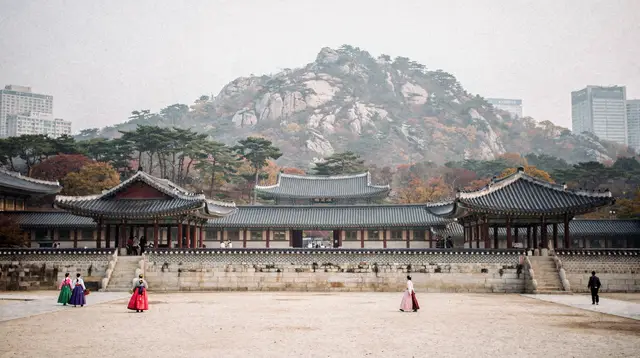
Gyeongbokgung vs Changdeokgung vs Deoksugung
Which Seoul palace should I visit if I only have time for one?
Gyeongbokgung for scale and the changing-of-the-guard ceremony, Changdeokgung for the Secret Garden and the least-restored royal architecture, Deoksugung if you're already downtown near City Hall. With two palace visits available, pair Gyeongbokgung with Changdeokgung — they cover the most ground with the least overlap.
| Gyeongbokgung | Largest, most crowded, free changing-of-the-guard, 2-3 hrs |
| Changdeokgung | Best-preserved, UNESCO, Secret Garden (separate ticket), 1.5-2 hrs + garden |
| Deoksugung | Smallest, most central, hanok + Western Seokjojeon, 1-1.5 hrs |
Seoul has five royal palaces from the Joseon Dynasty still standing, and most visitors only budget time for one or two. That’s a reasonable call — three full palace visits in one trip is a lot of stone courtyards and roped-off throne halls, even for people who genuinely like this stuff. The question isn’t which palace is “best,” because each of the three most-visited ones does something different. This guide compares Gyeongbokgung, Changdeokgung, and Deoksugung head to head so you can decide which combination actually fits your trip, rather than defaulting to whichever one shows up first in search results.
The short version, if you’re deciding right now
Gyeongbokgung is the largest and most photogenic from the outside — wide courtyards, the Gyeonghoeru Pavilion over its pond, and the free changing-of-the-guard ceremony at the main gate. It’s also the most crowded, especially near the entrance, because it’s the default first stop for every first-time visitor and every hanbok-rental Instagram photo.
Changdeokgung is smaller at the front gate but wins on substance: it’s the best-preserved of the five, listed as a UNESCO World Heritage Site specifically because its layout follows the natural terrain instead of a rigid symmetrical grid, and it’s the only one with the Huwon (Secret Garden) — a separate, ticketed, guide-only walk through a royal garden that most repeat visitors rate higher than anything at Gyeongbokgung.
Deoksugung is the smallest and most convenient if you’re already downtown — it sits right next to Seoul City Hall and Jeong-dong, wedged between skyscrapers in a way none of the other palaces are. It’s also the only one with a mix of traditional hanok halls and a Western-style stone building (Seokjojeon), a leftover from the late-1800s period when Korea was opening up to European architectural influence. The Royal Guard Changing Ceremony at Deoksugung is a smaller, more theatrical version of Gyeongbokgung’s.
Gyeongbokgung Palace: go for scale, not solitude
Gyeongbokgung was the primary palace of the Joseon Dynasty, founded in 1395, burned down during the Japanese invasions of the 1590s, left in ruins for roughly 270 years, then rebuilt in the 1860s under Regent Heungseon Daewongun at a scale meant to project royal authority. Most of what stands today is 20th and 21st century reconstruction on the original footprint — the palace was demolished piece by piece during the Japanese colonial period, and restoration work is still ongoing in some sections.
What that means in practice: Gyeongbokgung is the most visually impressive palace from a distance — the widest courtyards, the tallest gates, the most dramatic mountain backdrop with Bugaksan behind the throne hall — but the interiors are largely inaccessible reconstructions viewed through doorways, not furnished rooms you walk through. If you’re expecting the layered, lived-in feel of a European palace tour, temper that expectation.
Gyeongbokgung is also the busiest of the five by a wide margin, particularly between the main gate and Geunjeongjeon (the throne hall), where hanbok-clad visitors queue for photos most of the day. Arriving right at opening is the only reliable way to see the front courtyard without dozens of people in every frame.
For a full breakdown of the neighborhood around it, see the Gyeongbokgung and Jongno destination guide, and for the hanbok free-entry mechanics specifically, see hanbok rental and free palace entry.
Hanbok rental with Gyeongbokgung Palace entryChangdeokgung Palace: the one repeat visitors rate higher
Changdeokgung was built as a secondary palace in 1405 but became the primary royal residence for most of the Joseon Dynasty after Gyeongbokgung burned — kings actually lived and governed here longer than at the larger, more famous palace. Because it was built to follow the natural contours of the land behind it rather than a strict north-south axis, the layout feels less formal and more organic: halls sit at slightly different angles, courtyards are smaller and more intimate, and the whole complex reads as lived-in rather than ceremonial.
The single biggest reason to prioritize Changdeokgung is the Huwon, commonly called the Secret Garden — a roughly 78-acre rear garden built around ponds, pavilions, and centuries-old trees, accessible only via a guided tour that runs on a separate, timed schedule from general palace admission. This is a separate ticket from the main palace entry, it has limited daily capacity, and it sells out on weekends and during peak seasons (spring and autumn), so book it deliberately rather than assuming you can walk up. Many visitors treat it as the single best palace experience in Seoul, precisely because guided-tour capacity limits keep crowds far lower than anywhere in Gyeongbokgung.
Changdeokgung’s front palace buildings are also, structurally, less rebuilt than Gyeongbokgung’s — a meaningful share of the original Joseon-era wooden structures survived intact, which is part of why UNESCO listed it in 1997 while passing over the larger, more heavily reconstructed Gyeongbokgung.
Changdeokgung, Bukchon, Gwangjang Market, and N Seoul Tower guided dayDeoksugung Palace: small, central, and architecturally odd in a good way
Deoksugung sits downtown next to Seoul City Hall, wedged between office towers and the Jeong-dong stone wall walking path in a way that makes it feel more like a park than a monument. It’s the smallest of the three, walkable in under two hours including the Royal Guard Changing Ceremony, which makes it the easiest palace to slot into a half-day that also includes Myeongdong or City Hall.
Its most distinctive feature is Seokjojeon, a Neoclassical stone building completed in 1910, built during the final years of the Korean Empire when the royal court was experimenting with Western architecture and diplomacy simultaneously. Walking from a traditional wooden hanok hall directly into a Greco-Roman colonnaded building, both inside the same palace wall, is a striking, slightly disorienting illustration of Korea’s turn-of-the-century political turmoil that neither Gyeongbokgung nor Changdeokgung can replicate.
Deoksugung is also next to the Jeong-dong-gil stone wall road, a tree-lined walking path along the palace’s outer wall that’s popular for an evening stroll and is genuinely pleasant regardless of whether you’ve paid for palace admission.
Deoksugung Palace heritage walking tourSide-by-side comparison
| Gyeongbokgung | Changdeokgung | Deoksugung | |
|---|---|---|---|
| Size | Largest | Mid-sized (+Secret Garden) | Smallest |
| Crowds | Most crowded | Moderate, garden capped | Quietest |
| Time needed | 2-3 hrs | 1.5-2 hrs + garden tour | 1-1.5 hrs |
| Signature feature | Changing-of-the-guard, Gyeonghoeru | Huwon Secret Garden | Seokjojeon (Western stone hall) |
| Nearest subway | Gyeongbokgung / Gwanghwamun | Anguk | City Hall |
Size and scale: Gyeongbokgung is the largest by a clear margin; Changdeokgung is mid-sized but effectively doubles in scope once you add the Secret Garden; Deoksugung is the smallest and most self-contained.
Crowd levels: Gyeongbokgung is consistently the most crowded, especially the front courtyard in the first two hours after opening. Changdeokgung’s general palace area is moderately busy but the Secret Garden portion is naturally capped by guided-tour group sizes. Deoksugung is the quietest of the three most days, partly because it’s smaller and partly because it competes with City Hall subway traffic rather than tourist foot traffic.
Architectural character: Gyeongbokgung is formal, symmetrical, and monumental. Changdeokgung is organic, terrain-following, and the most historically intact. Deoksugung is a genuine hybrid — traditional hanok halls next to a Western stone palace building, unlike anything else in the city.
Time needed: Budget 2-3 hours for Gyeongbokgung alone, or a half day if you’re pairing it with Bukchon Hanok Village next door. Changdeokgung needs 1.5-2 hours for the main palace plus a separately scheduled 60-90 minute Secret Garden tour — plan for half a day total once you factor in the timing gap between the two. Deoksugung is the fastest at 1-1.5 hours, making it the natural choice if you’re squeezing a palace into an otherwise packed day.
Free entry with hanbok: All three (plus Changgyeonggung and Gyeonghuigung) waive admission if you’re wearing a complete hanbok — top and bottom both — with the same rules across all five palaces. See hanbok rental and free palace entry for how the rule actually works and where the common mistakes happen.
Closure days: This is where guides most often get it wrong. Gyeongbokgung and the other four palaces do not share a single closure day — treating them as interchangeable on this point is the most common planning error visitors make. See palace closure days and Culture Day for the palace-by-palace breakdown before you lock in dates.
Which combination actually makes sense
One palace, first visit, limited time: Gyeongbokgung. It’s the most recognizable, has the best free ceremony, and pairs naturally with Bukchon Hanok Village and Insadong right next door.
One palace, you’ve researched a bit and want the “real” experience: Changdeokgung, specifically with the Secret Garden ticket included. It’s a longer, calmer visit and the garden alone justifies the extra planning.
Two palaces: Gyeongbokgung in the morning, Changdeokgung’s main grounds (skip the Secret Garden if you’re tight on time) in the early afternoon — they’re a 15-20 minute walk apart via Bukchon, so this pairing doubles as a Bukchon Hanok Village walk without extra transit.
Three palaces: Add Deoksugung as a separate half-day, ideally paired with Myeongdong for shopping and food rather than crammed into the same day as the other two. Trying to do all three plus Bukchon in a single day is the fastest way to turn a cultural trip into a forced march — pace it across two days if you can.
Combined ticket: A single combination ticket covering Changdeokgung (including the Secret Garden), Changgyeonggung, Deoksugung, Gyeongbokgung, and Jongmyo Shrine exists and is worth it if you’re realistically visiting three or more sites on the list within its validity window — check current pricing and validity at the gate or through an official vendor before assuming it applies to your itinerary.
Getting between them
All three sit within Seoul’s central districts and are connected by subway with no need for a taxi. Gyeongbokgung is served by Gyeongbokgung Station (Line 3) and Gwanghwamun Station (Line 5); Changdeokgung by Anguk Station (Line 3); Deoksugung by City Hall Station (Lines 1 and 2). Walking between Gyeongbokgung and Changdeokgung through Bukchon takes 15-20 minutes and is more pleasant on foot than by subway, since it cuts through the hanok alleys rather than around them.
Naver Map and KakaoMap both handle these routes reliably with correct subway exits — Google Maps does not provide reliable turn-by-turn transit directions in Korea, which matters more here than in most cities given how confusing multi-exit stations like Gwanghwamun can be. See why Google Maps doesn’t work in Korea for the full explanation, and the Seoul metro and T-money guide for getting your transit card set up before you land.
Food near each palace
Near Gyeongbokgung, the west-side streets around Tosokchon-style samgyetang (ginseng chicken soup) restaurants and the Gwanghwamun office-district lunch spots both work well, though the latter are aimed at local workers and get crowded exactly at noon. Near Changdeokgung, Insadong’s tea houses and Ikseon-dong’s converted-hanok cafés are a five-to-ten minute walk and make a good post-Secret-Garden rest stop. Near Deoksugung, Jeong-dong and the streets toward City Hall have a mix of office-worker lunch counters and a growing café scene, plus easy access into Myeongdong for street food a few minutes further south.
What isn’t worth the extra planning
Trying to see all five royal palaces (adding Changgyeonggung and Gyeonghuigung) in one trip is rarely worth it unless palace architecture specifically is the reason you’re visiting Seoul — Changgyeonggung and Gyeonghuigung are smaller, less distinct from Changdeokgung, and best treated as a bonus stop if you’re already in the neighborhood rather than a dedicated destination. Paying extra for a “professional” hanbok photo package near any of the three main palaces is rarely necessary — a phone camera and the free entry itself covers most people’s needs, and you can wear the rental outfit to Bukchon or Insadong afterward for more photos without paying twice.
Where this fits in a longer Seoul trip
If you’re building a first-timer’s route, the Seoul 3-day itinerary typically anchors day one around Gyeongbokgung and Bukchon, leaving Changdeokgung as an optional add for travelers with more time. Families should check Seoul with kids before committing to a two-palace day — younger children tend to run out of patience for stone courtyards faster than adults expect.
If cherry blossom timing is shaping your dates, the Seoul cherry blossom guide covers how palace grounds bloom relative to the rest of the city. And if you’d rather skip the palace circuit for a view instead, Namsan Tower: cable car vs hike is the other classic first-timer decision point.
For general orientation before you build out your route, Seoul neighborhoods explained and 25 things to know before visiting Seoul both cover ground that applies well beyond the palace circuit, and the Seoul budget guide puts palace and hanbok costs in context against a full day’s spending.
Frequently asked questions about choosing between Seoul’s palaces
Is Changdeokgung really better than Gyeongbokgung, or just different?
Different, mostly — but the Secret Garden genuinely is a standout experience that Gyeongbokgung has no equivalent for. Gyeongbokgung wins on scale, photogenic courtyards, and the free changing-of-the-guard ceremony. Changdeokgung wins on historical authenticity, atmosphere, and the guided garden walk. Most repeat visitors to Seoul name Changdeokgung as their favorite, but first-timers usually still start with Gyeongbokgung.
Do I need to book the Changdeokgung Secret Garden in advance?
Booking ahead is strongly recommended, especially on weekends and during spring and autumn. The garden is guide-only with capped group sizes per tour slot, and walk-up tickets can sell out by midday during busy periods.
Can I wear the same hanbok rental to all three palaces in one day?
Yes — a hanbok rental isn’t tied to a single palace, so if your itinerary genuinely covers multiple palaces in one day, the same complete outfit gets you free entry at each one. Just factor in that most rental shops charge by time block, so a long multi-palace day may need a longer rental period.
Which palace is best for photos without crowds?
Changdeokgung’s Secret Garden, by a wide margin, since group sizes are limited by the guided-tour format. For a palace you can visit without booking ahead, Deoksugung is consistently the least crowded of the three main options.
Is Deoksugung worth visiting if I’ve already seen Gyeongbokgung?
Yes, if you have a spare hour or two near City Hall — the Western-style Seokjojeon building makes it architecturally distinct from anything at the other palaces, and it’s a genuinely easy add-on rather than a dedicated half-day trip.
Are the palace closure days the same for all three?
No, and this is the most common mistake in palace planning. Each of the five royal palaces has its own weekly closure day, and they don’t all match Gyeongbokgung’s. Check palace closure days and Culture Day before finalizing which day you’ll visit which palace.
Is the combined multi-palace ticket worth buying?
Only if you’re confident you’ll actually visit three or more of the covered sites within its validity window. If you’re only doing one or two palaces, paying individual admission usually works out similar or cheaper once you account for the ticket’s validity constraints.
Which palace pairs best with a Bukchon Hanok Village visit?
Gyeongbokgung and Changdeokgung both border Bukchon from opposite sides, so either works — but Gyeongbokgung’s side connects more directly to the famous alley photo spots, while Changdeokgung’s side flows into the quieter residential lanes.
Palace & heritage tours on GetYourGuide
Verified deep-linked GetYourGuide tours. Book through these links and we earn a small commission at no cost to you.
GetYourGuide does not provide product photos: on its activity cards, the picture illustrates the type of experience and is not the operator's own photo.
Seoul: Half-Day City Highlights & Palace Tour with Hanbok

Seoul City Sightseeing Tour Including Gyeongbokgung Palace, N Seoul Tower, and Namsangol Hanok Village