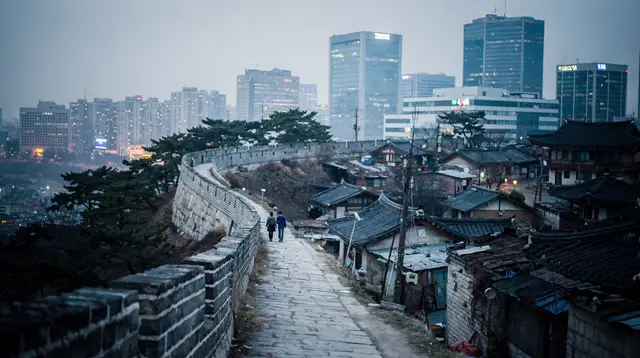
Gyeongbokgung Palace is the reason most first-time visitors build their whole Seoul trip around Jongno-gu, and it earns that role — but the palace itself is only half the neighborhood. Jongno stretches from the Gwanghwamun Gate plaza east through Bukchon Hanok Village, Samcheong-dong, and Insadong, and most travelers underestimate how much walking that covers. This guide breaks down what’s actually worth your time here, what’s a photo op and nothing more, and the scheduling mistakes that trip people up most (starting with the one day of the week the palace is shut).
| Where | Jongno-gu, central Seoul |
| Cost | A few thousand won admission; free in full hanbok or on Culture Day |
| Time needed | 2-3 hours for the palace; a full day with Bukchon and Insadong |
| Getting there | Gwanghwamun Station (Line 5) or Anguk Station (Line 3) |
| Never | Tuesdays — Gyeongbokgung is closed |
Getting oriented: Gwanghwamun, Bukchon, and Insadong aren’t the same stop
Jongno-gu is Seoul’s oldest administrative district, and it reads that way — this is where the Joseon Dynasty (1392-1897) built its main royal compound, and where the street grid still bends around palace walls instead of the other way around. Three sub-areas matter for planning:
Gwanghwamun and the palace itself sit at the northern end of Sejong-daero, a wide boulevard lined with government buildings and the statues of King Sejong and Admiral Yi Sun-sin. Gwanghwamun Station (Line 5, exit 2) puts you right at the plaza.
Bukchon Hanok Village is a residential hillside of traditional hanok houses between Gyeongbokgung and Changdeokgung Palace. It’s still a functioning neighborhood — people live in these houses — which is the whole point of visiting, and also why locals get frustrated by tour groups shouting outside their front doors. Anguk Station (Line 3, exit 2) is the closest stop.
Insadong is the antique-and-souvenir shopping street running south from Anguk, packed with tea houses, calligraphy shops, and stationery stores. It’s touristy by design, but it’s also the easiest place in Seoul to buy a decent souvenir that isn’t mass-produced plastic. Anguk Station and Jonggak Station both work.
Treat these as three separate stops connected by a 15-20 minute walk, not one attraction. Trying to cram the palace, Bukchon, and Insadong into a rushed morning is the single most common planning mistake for this district.
Gyeongbokgung Palace: the practical version
Gyeongbokgung was the primary royal palace of the Joseon Dynasty, largely destroyed during the Japanese invasions of the 1590s, rebuilt in the 1860s under the Regent Heungseon Daewongun, then torn down again piece by piece during the Japanese colonial period. What you see today is mostly post-1990s reconstruction — the government has been rebuilding structures on original foundations for three decades and the work is still ongoing in sections. That matters for expectations: this is not an untouched 500-year-old building, it’s a careful reconstruction, and some travelers find that disappointing if they weren’t told in advance.
Gyeongbokgung is closed every Tuesday. This is the single most important scheduling fact for this entire neighborhood, because a Tuesday closure doesn’t just cancel the palace — it also empties out the changing-of-the-guard ceremony and makes Bukchon and Insadong your default Tuesday plan instead. Don’t assume other palaces share the same closure day: Changdeokgung, Deoksugung, and the others each have their own schedule, and generalizing from Gyeongbokgung is the mistake most guidebooks make.
Standard admission is affordable (a few thousand won for adults), but most visitors skip the ticket line entirely by wearing a full hanbok, which gets you in free — more on that below.
Inside, prioritize by time available:
- Geunjeongjeon, the throne hall, is the visual centerpiece — a two-tiered stone platform facing a courtyard where officials once stood in rank order.
- Gyeonghoeru Pavilion, a raised wooden hall over a rectangular pond, is the single most photographed structure in the palace and worth timing for late afternoon light.
- Hyangwonjeong Pavilion, a smaller hexagonal pavilion on its own pond toward the palace’s north end, gets a fraction of the crowd Gyeonghoeru does and is arguably prettier.
- The National Folk Museum of Korea sits inside the palace grounds (separate free entry) and is a solid rainy-day fallback if you’ve already done the outdoor circuit.
The changing of the guard ceremony (Sumunjang) runs a few times a day at Gwanghwamun Gate on non-Tuesday days, with reenactors in Joseon-era military dress. It’s genuinely well done and free to watch from outside the gate — you don’t need palace admission to see it, just good timing.
Hanbok rental: how the free-entry rule actually works
This is the detail that trips up more visitors than any other in Seoul: wearing a hanbok gets you free entry to all five royal palaces (Gyeongbokgung, Changdeokgung, Deoksugung, Changgyeonggung, and Gyeonghuigung), but only if you’re wearing a complete hanbok — top (jeogori) and bottom (chima or baji) both on. A single hanbok-style accessory, a rented top over your own jeans, or a “hanbok-inspired” outfit from a costume rack doesn’t count, and staff at the ticket gate do check.
Rental shops cluster around the Gyeongbokgung side streets and along the walk toward Bukchon, with prices and quality varying a lot — some shops rent worn, ill-fitting sets for a low price, others offer better fabric and styling for more. If you want the free-entry-plus-photos combo without shopping around shop to shop, a bundled rental-and-entry option removes the guesswork:
Hanbok rental with Gyeongbokgung Palace entryA few practical notes locals wish visitors knew: comfortable shoes matter more than the outfit (you’ll be on uneven stone for hours), most shops include simple hair accessories in the rental price, and midday summer heat inside a full hanbok is no joke — an early morning or late afternoon slot is more comfortable than a noon rental in July or August.
Separately, the last Wednesday of every month is Culture Day, when all five palaces (plus several museums and other cultural sites) are free to enter for everyone, hanbok or not. It’s popular, so expect more foot traffic than a normal day, but it’s a genuinely useful date to build a trip around if your dates are flexible.
Bukchon Hanok Village: come for the alleys, not just the photo spots
Bukchon sits on the hillside between Gyeongbokgung and Changdeokgung and is one of the last intact traditional neighborhoods in central Seoul. The postcard shot — a narrow stone alley with hanok roof tiles curving away downhill — is usually Bukchon-ro 11-gil, and it is genuinely photogenic. It’s also, by mid-morning, packed with tour groups and tripods, and residents have posted “quiet please, people live here” signs in multiple languages because visitors regularly peer into windows or block driveways.
The honest advice: go before 9am or after 5pm if photography is your priority, and treat the daytime hours as a walking neighborhood rather than a photo shoot. Wander the quieter lanes one or two streets over from the famous alley — you’ll get a similar feel with none of the crowd, plus a better sense of how the neighborhood actually functions (small galleries, tea houses, the odd guesthouse converted from a family home).
The Bukchon Traditional Culture Center offers a free look at hanok architecture and occasional craft demonstrations if you want context beyond the alley walk.
Insadong: souvenirs, tea houses, and Ssamziegil
Insadong-gil is the main pedestrian shopping street, closed to cars on Sundays, running south from Anguk Station toward Jongno. It’s the most reliable place in the city to buy calligraphy brushes, hanji (traditional paper) goods, celadon pottery, and tea — real crafts, not just keychains, though plenty of keychains exist too.
Ssamziegil is a spiral-ramp shopping complex just off the main street, built around small independent studios and design shops rather than chain stores — worth 20-30 minutes even if you’re not buying anything, mostly for the architecture. Insadong’s traditional tea houses (a step off the main drag, tucked into converted hanoks) are a legitimate way to rest your feet mid-afternoon; expect to pay more than a regular café for the setting and the ceremony of it, which is the point.
Jogyesa Temple, a five-minute walk from Insadong’s north end, is the head temple of the Jogye Order of Korean Buddhism and free to enter. It’s a working temple, not a museum — expect to see monks and worshippers going about actual religious practice, so keep voices down and don’t treat it purely as a photo backdrop.
If you’d rather have someone connect the palace, Bukchon, and the temples into one guided route instead of self-navigating, this half-day option covers the core sites with a guide:
Gyeongbokgung, Folk Museum, Bukchon, and Jogyesa Temple tourFood in the neighborhood
Jongno isn’t Seoul’s top food destination — that’s Myeongdong or Gwangjang Market a short subway ride away — but there’s enough here to eat well without leaving the area. Tosokchon Samgyetang, near Gyeongbokgung’s west side, is a well-known ginseng chicken soup restaurant that regularly has a line out the door at lunch; it’s popular with locals as well as tourists, which is a reasonable signal of quality, but budget 30-45 minutes of queue time. Gwanghwamun Jip and other older restaurants around the Sejong-daero area serve solid, no-frills Korean lunch sets aimed at office workers, which usually means honest pricing since the customer base isn’t tourists.
Around Insadong, sit-down restaurants along the main street tend to run 20-30% above equivalent food elsewhere in the city — you’re paying a location premium. Ducking one block off the main drag fixes that without sacrificing much.
What isn’t worth the detour
Gyeongbokgung’s reconstructed interior rooms are mostly roped-off and viewed from doorways — if you’re expecting furnished palace interiors like European royal residences, temper expectations; Joseon palace architecture is about the building envelope and courtyard layout more than staged interiors. Paid photo studios near the palace gates offering “professional hanbok portraits” for a large markup over a standard rental are a common upsell — a phone camera and decent light does the job for most people, and the rental shops themselves usually let you keep the outfit for photos elsewhere in the neighborhood.
A realistic one-day budget
For a solo traveler doing the full loop — palace, hanbok, Bukchon, Insadong, lunch, one tea house stop — a reasonable daily spend runs 80,000-120,000 KRW (roughly 60-90 USD), broken down as: hanbok rental with palace entry bundled in (the largest line item), a sit-down lunch near Gwanghwamun or Insadong, a tea house stop, one or two coffee or street snack breaks, and subway fares. Skipping the hanbok and paying standard palace admission instead cuts the day’s cost significantly, since the ticket itself is only a few thousand won. Souvenir spending in Insadong is the wildcard — it’s easy to spend far more than planned in the pottery and hanji paper shops if you’re not tracking it.
If you’re building a broader daily budget for the whole trip, the Seoul budget guide breaks down backpacker, mid-range, and comfortable spending tiers across the whole city, and is Seoul expensive puts Korean prices in context against other Asian and European capitals.
Getting there and around
Gwanghwamun Station and Anguk Station (both accessible without transfers from most central Seoul hotel areas) bookend this district. Google Maps does not reliably route pedestrian directions or transit times in Korea — use Naver Map or KakaoMap instead, both of which have English-language interfaces and correctly show subway exits, which matters more than it sounds like it should in a city where the wrong exit can add 15 minutes of walking around a city block. For a fuller explanation of why Google Maps falls short here, see Why Google Maps doesn’t work in Korea.
A T-money card, loaded and tapped at any subway gate, is the simplest way to move between these stops — see the Seoul metro and T-money guide if you haven’t set one up yet.
Where this fits in a longer Seoul trip
Gyeongbokgung and Jongno anchor most first-day itineraries because it’s the most walkable introduction to old Seoul. If you’re comparing which of the five palaces deserve your limited time, see Gyeongbokgung vs Changdeokgung vs Deoksugung — Changdeokgung’s Secret Garden in particular is worth a half-day of its own and is often rated higher than Gyeongbokgung by repeat visitors. Also check palace closure days and Culture Day before locking in dates, since closure schedules differ palace to palace.
For neighborhoods to pair with a Jongno day, Myeongdong and Namdaemun is a 10-minute subway ride south for street food and shopping, and Bukchon flows directly into Seongbuk-dong and the northern hillsides if you want more hanok atmosphere without the crowds (different neighborhood, similar architecture). If cherry blossom timing is driving your dates, read the Seoul cherry blossom guide — the palace grounds and nearby Gyeongbokgung-adjacent streets bloom in early-to-mid April most years.
This district also anchors most structured itineraries: see the Seoul 3-day itinerary or the 5-day version for how a Gyeongbokgung morning typically slots against everything else on a first visit. Families should check Seoul with kids for pacing advice — a full palace-plus-Bukchon day is long for younger children.
Gyeongbokgung vs Changdeokgung: which comes first
Nearly every first-time visitor eventually asks whether to prioritize Gyeongbokgung or its neighbor Changdeokgung. A quick comparison for planning purposes:
| Gyeongbokgung | Changdeokgung | |
|---|---|---|
| Scale | Largest of the five palaces, grand and formal | Smaller, more intimate layout |
| Highlight | Geunjeongjeon throne hall, Gyeonghoeru Pavilion | Huwon (Secret Garden), timed guided-tour-only |
| Closed | Tuesdays | Mondays |
| Booking | Walk-up, no reservation needed | Secret Garden needs advance timed booking |
| Best for | First-time visitors, photography, the guard ceremony | Repeat visitors, garden and architecture lovers |
Because the two close on different days, a common and efficient pattern is Gyeongbokgung on one day and Changdeokgung (with the Secret Garden booked ahead) on another, rather than trying to rush both into a single afternoon. See the full palace comparison guide for how Deoksugung fits into the picture as a third option.
A realistic one-day route through the neighborhood
For visitors doing the full Gyeongbokgung-Bukchon-Insadong loop in one day, sequencing matters more than most itineraries admit. Start at the palace right at opening (9am) to beat both the heat and the tour-group crush, and catch the changing-of-the-guard ceremony if the timing lines up. From there, walk north into Bukchon while the alleys are still relatively quiet — late morning is the trade-off point where Bukchon’s crowds are building but Insadong hasn’t gotten busy yet.
Break for lunch around Anguk or Insadong’s edge rather than the main tourist strip, then spend the afternoon working south through Insadong toward Jogyesa Temple and Ssamziegil, finishing with a tea house stop before the walk back to a subway station. This order front-loads the two time-sensitive stops (the palace’s morning light and Bukchon’s crowd window) and treats Insadong, which stays lively all day, as the flexible back half of the schedule.
Frequently asked questions about Gyeongbokgung Palace and Jongno
Is Gyeongbokgung really closed every Tuesday, no exceptions?
Yes, with one caveat: if a Tuesday falls on a public holiday, the palace may stay open and shift its closure to the next non-holiday weekday instead. Check the official schedule for your specific travel dates rather than assuming.
Do I need to book palace tickets in advance?
No, standard admission is sold at the gate and rarely sells out. Hanbok rental shops can get busy on weekends and around cherry blossom season, so booking those ahead is more useful than booking palace entry itself.
What happens if I wear only a hanbok top, not the full outfit?
You’ll be charged regular admission. Staff at the ticket gate visually check for a complete top-and-bottom hanbok; partial outfits or “hanbok-inspired” streetwear don’t qualify for free entry.
Is Bukchon Hanok Village actually free to visit?
Yes — it’s a public residential neighborhood, not a ticketed attraction. There’s no admission fee; the only cost is time and, if you want it, a hanbok rental for photos.
How long does the changing of the guard ceremony last?
Each performance runs roughly 20-30 minutes and repeats a few times daily on non-Tuesday days at Gwanghwamun Gate. Arrive 10-15 minutes early for a clear sightline near the front.
Can I visit Gyeongbokgung and Changdeokgung in the same day?
Physically yes — they’re a 15-20 minute walk apart — but it’s a lot of walking on top of two full palace visits. Most people find one palace plus Bukchon and Insadong is a fuller, less rushed day than trying to fit two palaces in.
Is Insadong worth visiting if I’m not buying souvenirs?
Yes, in smaller doses. The tea houses, Ssamziegil’s architecture, and Jogyesa Temple all work as standalone stops even without shopping, though the main street’s appeal is mostly retail.
What’s the best time of day to photograph Gyeongbokgung without crowds?
Right at opening, generally 9am, before tour groups arrive — and for Bukchon specifically, before 9am or after 5pm, since midday is consistently the most crowded window in the famous alleys.
Should I visit Gyeongbokgung or Changdeokgung first if I only have time for one?
Gyeongbokgung generally comes first for most travelers — it’s larger, more visually grand, and free with a hanbok rental, making it the more natural introduction to Korean palace architecture. Changdeokgung’s Secret Garden rewards a second, less rushed visit once you have a sense of what to look for.