Seoul cherry blossom season
When is cherry blossom season in Seoul?
Typically late April into early May, though the exact bloom window shifts year to year by up to a week or two depending on spring temperatures — check a current-year forecast closer to your trip rather than locking in dates months ahead. Full bloom usually lasts less than two weeks before petals start falling.
Cherry blossom season is the single most weather-dependent trip-planning decision in Seoul. Miss the window by a week in either direction and you get bare branches or brown petals on the ground instead of the pink canopy everyone’s chasing. This guide covers when it actually happens, where to see it without fighting the biggest crowds of the year, and what to do if your dates land a little early or late.
| Where | Yeouido, Seokchon Lake, palace grounds, Seoul Forest |
| Window | Mid-April to early May, shifts yearly |
| Duration | Full bloom typically under 2 weeks |
| Cost | Free to view; palace entry fees still apply |
| Booking | Reserve hotels early — this is peak season |
Why the exact timing is impossible to promise months out
Cherry blossom bloom dates in Seoul move with spring temperatures, not the calendar — a warm March pulls the bloom earlier, a cold snap in early spring pushes it back, and the gap between an early year and a late year can be a week or more. Regional forecasters publish updated bloom predictions as spring approaches, refining estimates as the season gets closer, and the most reliable approach is checking a current forecast a few weeks before your trip rather than booking flights around a date fixed a year in advance. If your travel dates are already locked in and can’t move, treat cherry blossoms as a bonus rather than the trip’s centerpiece — that way an early or late bloom doesn’t sink the whole visit.
As a general rule, expect the window to fall somewhere in the stretch from mid-April through early May, with full bloom typically lasting under two weeks before petals begin dropping. Trees at lower elevations and in warmer microclimates (like riverside parks) tend to bloom slightly ahead of trees in shadier, cooler spots across the city, so even within Seoul the timing isn’t perfectly uniform.
Where to see cherry blossoms in Seoul
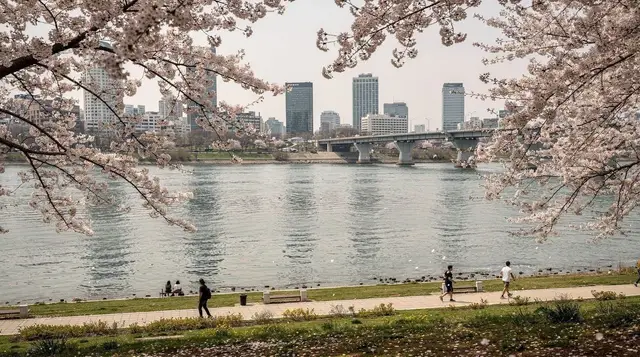
Yeouido, specifically the roughly 1,700-tree stretch along Yunjungno near the National Assembly building, is the single most famous cherry blossom spot in the city and also, predictably, the most crowded. It’s genuinely spectacular at peak bloom — a tunnel of blossoms running for over a kilometer — but expect dense foot traffic, food stalls, and a festival atmosphere rather than a quiet stroll. Go on a weekday morning if crowds are a concern; weekend afternoons during peak bloom are close to shoulder-to-shoulder in the busiest stretch. See Yeouido and the Han River for the rest of what’s around it.
Seokchon Lake, next to Lotte World in Jamsil, offers a lake-reflection version of the same idea with a different crowd profile — busy, but generally more manageable than Yeouido at peak times, and it doubles as a scenic stop if you’re already headed to Lotte World. See Jamsil and Lotte World.
Namsan and the Gyeongbokgung area both get cherry blossom coverage without being dedicated blossom destinations the way Yeouido is — a genuine advantage if you want the flowers as a backdrop to sightseeing you’d be doing anyway rather than a dedicated pilgrimage. The palace grounds and the streets approaching Gyeongbokgung fill in nicely during the bloom window; see Gyeongbokgung and Jongno.
The Han River bike path more broadly has scattered cherry trees along long stretches, which means you can find a quieter, less curated blossom experience just by riding or walking sections away from the Yeouido concentration.
More spots worth knowing about
Seoul Forest, in Seongdong-gu near Seongsu-dong, mixes cherry trees into a much larger park setting alongside deer enclosures and open lawns, giving it a fundamentally different feel from Yeouido’s linear tree tunnel — a good option if you want blossoms alongside a broader park day rather than a dedicated pilgrimage. It pairs naturally with a Seongsu-dong café stop, given how close the two are — see Seongsu-dong.
Olympic Park, in the city’s southeast, is large enough that cherry blossom crowds spread out considerably more than at concentrated spots like Yeouido, and it has the added benefit of sculpture and green space to explore beyond the trees themselves if blossoms alone aren’t enough to fill a visit.
Namsan’s lower slopes, particularly near the Myeongdong-side trailheads, pick up scattered blossoms as part of the general spring greenery — not a dedicated destination, but a pleasant bonus if a Namsan visit is already on your itinerary during the season. See Namsan Tower: cable car vs hike.
Changgyeonggung Palace, somewhat overlooked relative to Gyeongbokgung and Changdeokgung for general sightseeing, gets a genuinely strong cherry blossom showing along its grounds and is meaningfully less crowded during bloom season than the bigger-name palaces nearby.
Night viewing and blossom festivals
Some of Seoul’s cherry blossom spots run evening illumination during peak bloom, lighting the trees after dark for a softer, lantern-lit version of the daytime crowds — Yeouido in particular has hosted evening festival programming in past seasons, complete with food vendors and performances that extend well past sunset. These events aren’t guaranteed to repeat in exactly the same form each year, so check what’s actually running as your trip approaches rather than assuming a specific festival format.
Night viewing tends to thin the crowds slightly compared to peak daytime hours, since a portion of visitors treat blossom viewing as a daytime-only activity, while also adding a genuinely different atmosphere — cooler temperatures, illuminated branches against a dark sky, and a slower, less rushed pace than the packed daytime paths.
Photography tips for a better blossom shot
Early morning light, generally within the first hour or two after sunrise, gives softer, more flattering light on the blossoms than the harsher midday sun, and it comes with the added benefit of thinner crowds before the day’s foot traffic builds. Overcast days, counterintuitively, often produce better blossom photos than bright sunny ones, since diffused light avoids the harsh shadows and blown-out highlights that direct sun creates on pale pink petals.
If a hanbok-and-blossoms photo is part of your plan, pairing a palace-grounds blossom visit with a hanbok rental (which also gets you free palace entry) is more efficient than treating the two as separate outings — see hanbok rental and free palace entry.
Beyond Seoul: bigger, less crowded blossom trips
Some of Korea’s most celebrated cherry blossom festivals happen outside Seoul entirely, and for travelers with a flexible day to spare, they’re worth the trip specifically because the scale and setting outclass anything inside the city. Jinhae, on the southern coast, hosts one of the country’s largest and most famous cherry blossom festivals, with entire hillside neighborhoods and a river lined in blossoms — it’s a longer day trip from Seoul than the DMZ or Nami Island, so it’s more realistic as a dedicated day than an add-on.
Jinhae or cherry blossom spring flower tour from SeoulCloser to Seoul, combined itineraries pairing cherry blossoms with cultural or historical stops around Incheon offer a lighter-commitment alternative to the full Jinhae trip.
Seoul and Incheon cultural history tour with cherry blossomAnd travelers combining a cherry blossom day with Jeonju’s hanok village and traditional architecture get a two-for-one that works well if blossoms alone don’t justify a dedicated day trip on their own.
Maisan cherry blossom and Jeonju hanok day tourWhat crowds actually look like at peak bloom
Peak bloom weekends at Yeouido specifically draw some of the largest single-location crowds Seoul sees all year, on par with major festival days elsewhere in the city. Expect packed subway cars headed toward Yeouinaru Station, food vendors lining the main path, and a genuinely festive but chaotic atmosphere rather than a peaceful nature walk. If that’s not what you’re after, the palace grounds, Han River sections away from Yeouido, or a day trip to Jinhae or Incheon all offer a calmer version of the same season.
Weather adds another layer: rain and wind are cherry blossom season’s real enemy, since heavy rain can strip petals within a day or two of a storm passing through. If your trip includes a rainy stretch during the bloom window, prioritize blossom viewing on the clearer days and save indoor plans for when the weather turns — see the jangma rainy season guide for how to handle rain more broadly, though note that jangma itself falls later in the year than cherry blossom season and isn’t usually a factor during peak bloom.
Getting to the main spots without the confusion
Yeouido: the closest station is Yeouinaru on Line 5, which puts you right at the riverside path near the main blossom stretch — expect this station specifically to be at its busiest during peak bloom weekends, with platform crowding that can add real time to what should be a quick exit. Seokchon Lake: Jamsil Station (Lines 2 and 8) or Sports Complex Station both work, and the walk from either is flat and straightforward.
Seoul Forest: Ttukseom Station (Line 2) or the Bukbu Rapid Transit’s dedicated Seoul Forest stop both connect directly. As with the rest of Seoul, Naver Map or KakaoMap will route you correctly through these stations’ multiple exits — see why Google Maps doesn’t work in Korea if you haven’t already switched navigation apps.
Blossom varieties: not all pink is the same
Most of the trees lining Yeouido and similar spots are Yoshino cherry (somei-yoshino), the pale pink-to-white variety most people picture when they think of cherry blossoms, and the one responsible for the dense, tunnel-like canopy effect at peak bloom.
Korea also has native cherry varieties and other spring-blooming trees mixed into some parks — including deeper pink varieties that bloom slightly later than the main Yoshino wave — which is part of why a park can still show good color a few days after the main citywide bloom has technically peaked. It’s a minor detail, but it explains why blossom timing isn’t perfectly uniform even within the same week, and why a park written off as “past peak” by an early visitor can still be worth a look days later.
What if your trip dates miss the window
If you arrive before full bloom, buds and early blossoms are still worth seeing, particularly at Yeouido where the sheer tree density means even a partial bloom looks substantial. If you arrive just after peak, look for spots with later-blooming varieties or shadier locations where trees lag the main bloom by a few days — palace grounds and hillside parks tend to run slightly behind riverside spots like Yeouido. If you’ve missed the window entirely, the Seoul autumn foliage guide covers Seoul’s other major seasonal color event, generally considered by locals to be the more reliably spectacular of the two given autumn’s more predictable, longer bloom window.
Booking around the season
Hotels in central Seoul, particularly anything near Yeouido or with river views, book up and raise rates during the bloom window, so reserve earlier than you would for a random spring week. The same applies to popular restaurants near major blossom spots. If your dates are flexible, arriving a few days before the earliest forecasted bloom date and staying through the tail end gives you the best odds of catching at least a few good days regardless of exactly when peak bloom lands that year.
Cherry blossom season, stage by stage
| Stage | What to expect | Crowds |
|---|---|---|
| Early buds (roughly 1-2 weeks before) | Pink tinge on branches, not yet photogenic | Light |
| First bloom | Scattered open blossoms, still building | Light-moderate |
| Full bloom | Dense pink canopy, the postcard window | Heaviest — especially Yeouido weekends |
| Petal fall | A pink “snow” effect on the ground for a day or two, then bare branches | Thins quickly |
Full bloom is the narrowest of these stages — often under a week of genuinely peak conditions — which is why locking in a single travel date months ahead is such a gamble. A trip spanning 5-7 days anywhere within the general mid-April-to-early-May window has good odds of catching at least the tail end of full bloom or the petal-fall stage, both of which are still worth seeing even if you miss the absolute peak.
Combining a blossom day with the rest of your itinerary
A cherry blossom stop rarely needs its own dedicated day — it slots naturally into sightseeing you’re likely already doing. A morning at Gyeongbokgung and Jongno picks up palace-grounds blossoms without a special trip, and an evening Han River walk or Yeouido and Han River stop pairs easily with dinner nearby. Travelers building a first-time itinerary around the Seoul 7-day itinerary can usually work in two or three blossom stops across different days rather than treating Yeouido as a single make-or-break outing — that way one crowded, drizzly, or off-peak day doesn’t sink the whole blossom experience.
Where this fits in a longer Seoul trip
Cherry blossom season overlaps with one of Seoul’s most crowded and expensive travel windows, so if flexibility is on the table, weigh it against the Seoul autumn foliage guide — many repeat visitors and locals rate autumn as the better overall travel season despite spring’s blossom fame. If you’re building a spring itinerary anyway, the Seoul 3-day itinerary and the 5-day version both work well with a Yeouido or palace-grounds blossom stop worked in.
Families should check Seoul with kids for how to handle the Yeouido crowds with younger children, and where to stay in Seoul is worth reading before booking if a Yeouido-adjacent stay is part of the plan. For getting to Yeouido or Han River spots reliably, see the Seoul metro and T-money guide.
Frequently asked questions about Seoul cherry blossom season
What month should I book my flights for cherry blossoms?
Book with a target window rather than a single date — flexibility of a week or two around your best-guess timing meaningfully improves your odds, since exact bloom dates aren’t reliably known until close to the season itself.
Is Yeouido worth it if I hate crowds?
It depends on how much the specific tunnel-of-blossoms photo matters to you. If crowds are a dealbreaker, the palace grounds, quieter Han River stretches, or a day trip to Jinhae or Incheon all deliver blossoms with a fraction of Yeouido’s foot traffic.
How long does peak bloom actually last?
Typically under two weeks from first bloom to petals falling in significant numbers, with the best few days — full bloom before any petal drop — often a narrower window than that.
Can I see cherry blossoms and autumn foliage on the same trip?
No — they’re roughly six months apart on the calendar, so a single trip can only catch one or the other, not both.
Is rain during cherry blossom season common?
It can happen, and heavy rain is the biggest threat to a good bloom since it strips petals quickly. This is separate from jangma, Korea’s main rainy season, which typically falls later in the year.
Are cherry blossoms free to see everywhere in Seoul?
Yes — none of the major viewing spots (Yeouido, Seokchon Lake, Han River paths, palace grounds) charge admission specifically for blossom viewing, though palace entry fees still apply where relevant.
What if I can only travel in a fixed week and it doesn’t align with peak bloom?
Treat blossoms as a bonus, not the trip’s anchor. Even outside peak bloom, partial blossoms, budding trees, or the tail end of the season are still visually worthwhile, and the rest of Seoul’s spring sightseeing isn’t diminished by missing the exact peak week.
Do hotel prices really spike during cherry blossom season?
Yes, particularly for anything near Yeouido or with river views — book earlier than you would for an average spring week if your dates overlap the likely bloom window.
Are all the cherry trees in Seoul the same variety?
Mostly, but not entirely — the pale pink-to-white Yoshino variety dominates the famous spots like Yeouido, but some parks mix in native and deeper-pink varieties that bloom slightly later, which is why a park can still look good a few days after the main citywide peak has technically passed.
Seasonal experiences on GetYourGuide
Verified deep-linked GetYourGuide tours. Book through these links and we earn a small commission at no cost to you.
GetYourGuide does not provide product photos: on its activity cards, the picture illustrates the type of experience and is not the operator's own photo.