Itaewon developed around a U.S. military base presence starting in the mid-20th century and grew into Seoul’s most internationally mixed neighborhood — the place to go for Nigerian, Turkish, Indian, Mexican, and dozens of other cuisines you won’t find concentrated anywhere else in the city, plus a nightlife scene that draws a genuinely diverse crowd of Koreans, long-term expats, and visitors. Haebangchon, usually shortened to HBC, is the residential hillside just west of Itaewon proper, climbing toward Namsan — smaller in scale, less commercial, and the neighborhood where a lot of Seoul’s foreign residents actually live rather than just visit.
| Where | Itaewon Station (Line 6) and the HBC hillside just west, Yongsan-gu |
| Cost | International meal 15,000–25,000 KRW/person; night out 60,000–100,000 KRW |
| Time needed | Half day to a full evening |
| Getting there | Itaewon or Noksapyeong Station, Line 6 |
| Best time | Evening for food and bars; late afternoon for the Namsan hike before sunset |
Itaewon vs. Haebangchon at a glance
| Itaewon | Haebangchon (HBC) | |
|---|---|---|
| Vibe | Dense, commercial, busiest at night | Quieter, residential, neighborhood-y |
| Best for | International food variety, nightlife | Slower dinners, independent bars, locals |
| Access from station | Right at Itaewon Station exits | 10-15 min uphill walk, or short taxi |
| Namsan hike access | Via HBC’s upper streets | Trailhead starts here |
Itaewon: the main strip and what it’s really for
Itaewon Station (Line 6, exits 1-4) sits at the center of the district. The main street running east from the station is where most first-time visitors spend their time — a dense stretch of bars, international restaurants, and shops, busiest by far on weekend nights. During the day, it’s noticeably calmer, with restaurants doing steady lunch business and shops open for browsing rather than the bar-hopping crowd that arrives after dark.
The food is Itaewon’s strongest, most differentiated draw. This is the neighborhood to go to if you’ve had a few days of Korean food and want a change — genuinely well-regarded Turkish kebab spots, Indian restaurants run by actual South Asian chefs rather than Korean interpretations, Mexican taquerias, and a growing halal food scene serving the area’s Muslim community and visitors alike. It’s also, unsurprisingly, one of the more expensive dining areas in Seoul relative to the rest of the city, since imported ingredients and rent both run higher here.
Nightlife spans a wide range, from expat sports bars to rooftop cocktail lounges to LGBTQ+-friendly venues concentrated on what’s known locally as “Homo Hill,” a short strip that’s one of the few visibly queer nightlife areas in Seoul. For a structured first night out, a guided pub crawl removes the guesswork of picking venues cold:
Itaewon nightlife tour and pub crawlA note on caution, stated plainly: Itaewon has, at times, seen serious crowd-safety incidents during peak holiday nights (most notably a fatal crowd crush during Halloween 2022). The neighborhood has since increased crowd management for major nights out, but the underlying lesson holds for any dense nightlife district anywhere: avoid narrow alleys during extreme crowding, especially around Halloween and New Year’s Eve, and leave early if a street starts to feel packed beyond comfortable movement.
Haebangchon: Itaewon’s quieter neighbor
HBC sits on the hillside climbing west and north from Itaewon Station toward Namsan, reachable by a 10-15 minute walk uphill (or a short taxi if you’d rather skip the climb). The name means “liberation village,” referencing its post-1945 origins as a settlement for returnees and refugees; today it’s a low-rise residential neighborhood with a noticeably calmer, more neighborhood-y feel than Itaewon’s main strip.
HBC’s main street, Sinheung-ro, is lined with small independent restaurants, craft beer bars, and cafes — fewer chains, more one-off spots run by their owners, catering to a mix of long-term foreign residents and younger Koreans priced out of, or simply less interested in, Itaewon proper’s busier scene. It’s a good neighborhood for a slower dinner and a couple of drinks without the density of Itaewon’s peak-hour crowds.
The Namsan hike from HBC: the underused option
This is the detail most Itaewon guides skip. HBC sits at the base of Namsan, the forested hill in central Seoul topped by N Seoul Tower, and a marked hiking trail climbs directly from the neighborhood’s upper streets to the summit — roughly 30-45 minutes of uphill walking depending on fitness and pace, versus queuing for the cable car from the Myeongdong side. It’s a genuinely pleasant urban hike through pine forest with periodic viewpoints back over the city, and it’s far less crowded than the cable car approach.
At the top, N Seoul Tower’s observation deck offers 360-degree views over Seoul, and the surrounding plaza is home to the well-known “love locks” fence, where couples attach padlocks as a romantic gesture — genuinely popular with both Korean and international visitors, and more charming in person than the concept sounds. If you’d rather combine the tower entry with the cable car (useful if you’re hiking up but don’t want to hike back down, or vice versa), a bundled ticket covers both:
N Seoul Tower observatory and cable car combo ticketFor a comparison of hiking Namsan versus taking the cable car (cost, time, effort trade-offs), see Namsan Tower cable car vs hike.
Inwangsan: a lesser-known hike nearby
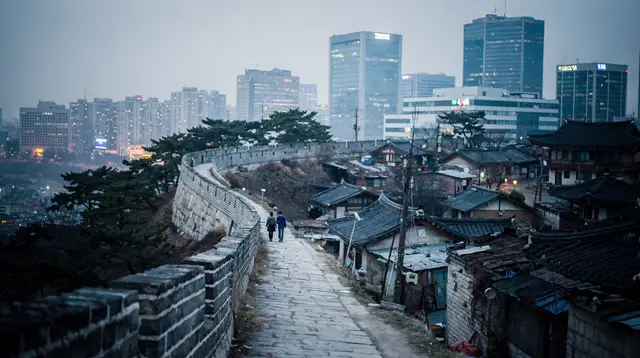
A short taxi or bus ride from Itaewon (or reachable via a transfer through Dongnimmun Station), Inwangsan is a smaller, rockier peak northwest of the Itaewon-HBC area known for its Seoul Fortress Wall sections, shamanist shrines, and — increasingly popular with photographers — sunset views over the city skyline framed by the wall’s stone ramparts. It’s a genuinely different hiking experience from Namsan: rockier terrain, fewer tourists, and a stronger sense of Seoul’s older spiritual practices still active in the small shrines along the trail.
Weekend sunset hiking tour on InwangsanFor hikers planning a bigger mountain day beyond either of these, the Bukhansan hiking guide covers Seoul’s larger, more serious national park option on the city’s northern edge.
Itaewon’s markets and shopping
Itaewon Antique Furniture Street, running along one of the side streets near the station, is a genuine curiosity — a concentration of shops selling Korean and Asian antique furniture, popular with long-term expats furnishing apartments rather than day-trippers, but worth a browse even if you’re not buying. Itaewon also has a longstanding reputation as a place to find larger clothing and shoe sizes than typical Korean retail carries, a holdover from the neighborhood’s history serving the international military and expat community.
The military and international history behind the neighborhood
Itaewon’s international character isn’t accidental — it developed directly around Yongsan Garrison, the former U.S. military base that occupied a huge swath of land immediately north of the neighborhood for decades. Base personnel and their families shaped Itaewon’s early restaurant and retail scene from the mid-20th century onward, which is part of why the neighborhood built such a deep bench of international cuisine and English-language service decades before the rest of Seoul caught up.
The base itself has been undergoing a long-planned relocation and handover process, with much of the former garrison land being converted into Yongsan Park, a major new green space for the city — a slow-moving but significant shift in the neighborhood’s immediate surroundings that’s changing Itaewon’s edges even as its core commercial identity stays recognizable.
What isn’t worth the detour
Some of Itaewon’s most heavily marketed “rooftop bar” venues charge a significant premium for a mediocre view and average drinks, trading on Instagram appeal rather than quality — check recent reviews before committing to cover charges or minimum spends at any rooftop specifically advertised as a photo destination. Similarly, a handful of “authentic” international restaurants along the main tourist-facing strip are considerably less authentic (and more expensive) than equivalents one or two streets back, run by owners actually from the cuisine’s country of origin rather than a Korean interpretation aimed at tourists.
A realistic budget for the district
International food in Itaewon runs noticeably higher than Korean food elsewhere in the city — a sit-down meal at a Turkish, Indian, or Mexican restaurant typically costs 15,000-25,000 KRW per person, more at the neighborhood’s better-regarded spots. A night out combining dinner, a couple of drinks, and a cover charge somewhere can reasonably run 60,000-100,000 KRW per person. The Namsan hike from HBC is free beyond whatever water or snacks you bring, making it one of the better free additions to an otherwise pricier evening in this district. See the Seoul budget guide for how Itaewon’s costs compare to cheaper neighborhoods like Hongdae or Jongno.
Seasonal notes
The Namsan hike from HBC is most comfortable in spring and autumn, when the forested trail isn’t dealing with summer’s heat and humidity or winter’s icy patches on steeper sections — proper footwear matters more in winter specifically. Itaewon’s outdoor rooftop bars and patio seating are a seasonal draw from late spring through early autumn, closing or moving indoors once the weather turns. If your trip overlaps with the jangma rainy season, see the jangma rainy season guide for how heavy rain affects the Namsan trail specifically — it can turn slippery enough to reconsider the hike in favor of the cable car on the wettest days.
Getting there and around
Itaewon Station (Line 6) is the main access point; Noksapyeong Station, one stop west, is closer to HBC’s upper streets and the Namsan trailhead if you want to skip walking through Itaewon’s main strip first. As throughout Seoul, use Naver Map or KakaoMap for walking directions — the neighborhood’s steep, winding streets are exactly the kind of terrain where Google Maps’ unreliable Korean pedestrian routing causes the most frustration; see why Google Maps doesn’t work in Korea for the full explanation.
Itaewon is also a reasonable base neighborhood for travelers who want proximity to international food and a livelier nightlife scene without staying in the more purely tourist-oriented Myeongdong — see where to stay in Seoul for a full comparison across neighborhoods, and Seoul neighborhoods explained for how Itaewon-dong fits into the wider Yongsan-gu district.
How this fits into a longer trip
Itaewon and HBC work well as an evening add-on to a day spent elsewhere — Gyeongbokgung and Jongno in the morning, Itaewon for dinner and drinks at night, is a common first-day pattern. It’s also a short subway ride from Gangnam and Apgujeong if you want to compare Seoul’s two most cosmopolitan nightlife districts in one trip. For itinerary placement, both the 5-day itinerary and the 7-day itinerary typically build in an Itaewon evening once travelers have had a couple of days of primarily Korean food and want variety.
If your visit overlaps with Halloween or New Year’s, read the safety note above again before finalizing plans — crowd density in Itaewon on those specific nights is a real planning factor, not a minor caveat.
Frequently asked questions about Itaewon and Haebangchon
Is Itaewon safe to visit given the 2022 crowd crush?
Yes, for the overwhelming majority of visits — Itaewon operates as a normal, busy nightlife and dining district most nights of the year. The elevated risk is specific to extreme-crowding events like Halloween weekend, when crowd density can spike dramatically; exercise the same caution you would at any packed festival or event anywhere in the world on those specific nights.
How long does the Namsan hike from HBC take?
Roughly 30-45 minutes uphill at a moderate pace, depending on fitness level and how many photo stops you make. It’s a well-marked, well-maintained trail suitable for most fitness levels, though it is a genuine uphill walk, not a flat stroll.
Is Itaewon LGBTQ+-friendly?
Yes — it’s home to Seoul’s most visible LGBTQ+ nightlife area, informally known as “Homo Hill,” and is generally considered one of the more openly welcoming neighborhoods in the city for LGBTQ+ visitors, though South Korea overall has more conservative social norms than many Western countries.
What’s the best day to visit Itaewon if I want to avoid crowds?
Weekday evenings or weekend daytime hours are noticeably calmer than Friday or Saturday night, when the main strip fills up considerably.
Do I need a reservation for Itaewon’s international restaurants?
Smaller, well-regarded spots can fill up on weekend evenings, so booking ahead or arriving early is worth it for a specific restaurant you have your heart set on. Many casual spots operate walk-in only regardless.
Is HBC walkable from Itaewon Station, or should I take a taxi?
It’s a comfortable 10-15 minute uphill walk from Itaewon Station, or a very short taxi ride if you’d rather not climb, particularly in summer heat.
Can I combine Namsan Tower and Itaewon nightlife in one evening?
Yes, and it’s a popular pairing — hike or cable-car up to N Seoul Tower for sunset, then head back down into Itaewon or HBC for dinner and drinks once it’s dark.
Is Itaewon good for solo female travelers?
Generally yes, given Seoul’s strong overall safety record, though the same common-sense precautions that apply to any nightlife district anywhere apply here too — stick to well-lit main streets late at night and keep track of drinks in busy bars.
Is HBC worth visiting if I only have time for Itaewon proper?
If time is genuinely limited, Itaewon’s main strip covers the bulk of the food and nightlife variety this district is known for. HBC is worth the extra 10-15 minute walk if you have a full evening free or want a calmer dinner spot away from the busiest blocks.
What’s the easiest way to combine Itaewon with a Namsan visit?
Walk or take a short taxi up into HBC, follow the marked trail to the Namsan summit for sunset, then either walk back down or take the cable car, and head into Itaewon or HBC for dinner once you’re back at street level. It’s a genuinely efficient way to combine a hike, a view, and a night out in one evening.
Is Itaewon good for finding halal food in Seoul?
Yes — it’s the most reliable single neighborhood in the city for halal-certified and halal-friendly restaurants, reflecting the area’s long-established Muslim community and the nearby Seoul Central Mosque, Korea’s first, located on a hill just above the main Itaewon strip.
How does Itaewon’s food scene compare to Seongsu-dong’s?
They’re not really comparable — Itaewon specializes in genuinely international cuisines from cooks with roots in those countries, while Seongsu-dong’s food scene is mostly modern Korean and Western-style cafes and bakeries with a design-forward presentation. Itaewon is the pick for cuisine variety; Seongsu-dong for a specific aesthetic experience.
Is there a good market or grocery stop in Itaewon for imported ingredients?
Yes — several small international grocery shops around the main strip stock ingredients (spices, specialty sauces, imported snacks) that are hard to find elsewhere in Seoul, a holdover from the neighborhood’s long history serving an international community that needed those products locally.