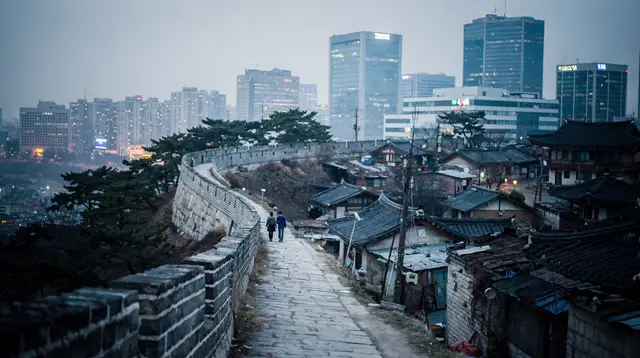
Dongdaemun (“Great East Gate,” named for the historic gate still standing at the district’s western edge) is Seoul’s largest fashion wholesale district and one of the few parts of the city that genuinely operates through the night. It’s also home to the Dongdaemun Design Plaza, Zaha Hadid’s sweeping, futuristic concrete building that reshaped the district’s skyline and its identity when it opened in 2014. The two sides of Dongdaemun — centuries-old market tradition and aggressively contemporary architecture — sit within a few minutes’ walk of each other, which is unusual even by Seoul standards.
| Where | Jongno/Jung-gu border, Dongdaemun & DDP stations |
| Cost | Retail items around 10,000-30,000 KRW; DDP mostly free |
| Time needed | Half day; overnight if wholesale shopping is the goal |
| Getting there | Dongdaemun Station (Lines 1, 4) or DDP Station (Lines 2, 4, 5) |
| Best time | Late afternoon for DDP; 10pm onward for wholesale floors |
The wholesale fashion market: how it actually works
Dongdaemun’s fashion district is a cluster of large multi-story buildings (Doota Mall, Migliore, Hello apM, and dozens of smaller ones) organized around a genuinely unusual rhythm: many buildings serve wholesale buyers — small boutique owners from around Korea and increasingly Southeast Asia and elsewhere — who arrive at night, buy in bulk, and leave before dawn to get product back to their own stores. That’s why parts of this market run on a nocturnal schedule that looks strange on paper until you understand who it’s built for.
For a casual visitor, this means two very different experiences depending on when you show up. Daytime visits hit retail-facing floors with fixed single-item pricing, comparable to shopping at any large mall, just with a denser concentration of small, independent fashion stalls than a typical Western mall. Late-evening-into-overnight visits (roughly 10pm onward) shift toward the wholesale floors, where bulk pricing dominates and single-item purchases are sometimes possible but not really the point — you’re witnessing a functioning trade market more than shopping in the conventional sense.
The honest take: unless you’re actually buying in bulk, the overnight wholesale experience is more interesting as a spectacle — a genuinely unusual slice of Seoul’s economy running while the rest of the city sleeps — than as a practical shopping trip. Budget travelers looking for cheap clothing are often better served by the daytime retail floors, which offer single-piece pricing without navigating wholesale minimums.
Dongdaemun Design Plaza (DDP)
The DDP, designed by the late Zaha Hadid, is a curving, largely windowless concrete structure that’s become one of Seoul’s most recognizable pieces of contemporary architecture — love it or find it out of place next to the old city wall remnants nearby, it’s genuinely worth seeing in person, especially after dark when its LED-lit exterior rose garden (a seasonal installation, not permanent) and the building’s own lighting design come alive.
Inside, the DDP hosts rotating exhibitions, design fairs, and Seoul Fashion Week events, plus a design museum and shop covering Korean design history. It’s a legitimate half-day stop on its own even without any interest in the surrounding fashion market, and its plaza area is a popular, free evening gathering spot for both locals and visitors.
Dongdaemun History and Culture Park, the subway station serving the DDP, doubles as an excavation site — sections of the old Seoul city wall and Joseon-era military facility ruins are preserved and viewable within the station complex itself, a detail easy to miss if you’re moving quickly between the market and the DDP above ground.
Night markets and street food
Dongdaemun’s night market scene runs alongside the wholesale fashion trade, with food stalls and smaller night markets (including a well-known nighttime flea and craft market held periodically near the DDP) drawing a mixed crowd of late-night shoppers, young locals, and visitors specifically there for the after-dark atmosphere. For a broader look at Seoul’s night market culture beyond this one district, see the Seoul night markets guide.
A guided night walk connecting Dongdaemun’s evening energy with the older Cheonggyecheon stream corridor and Gwangjang Market a short distance west covers a genuinely good stretch of Seoul after dark in one outing:
Nighttime tour of palace, market, Naksan Park, and moreGyeongdong Market and the ginseng district
A short subway ride northeast of Dongdaemun proper (Jegi-dong Station), Gyeongdong Market is Korea’s largest traditional herbal medicine market and a major hub for ginseng specifically — a completely different retail category from Dongdaemun’s fashion focus, and worth the detour if traditional medicine, ginseng products, or an unusual market atmosphere interest you. The market’s ginseng section in particular draws serious buyers and offers a look at a side of Korean commerce most fashion-focused visitors never encounter.
Gyeongdong and Ginseng Market tour with street food tastingFashion and personal styling
Given Dongdaemun’s identity as Korea’s fashion wholesale center, it’s a fitting neighborhood for a personal color and styling consultation if that’s on your list — a service more commonly associated with Korea’s broader beauty and fashion industry than with any single shopping trip here specifically, but logistically convenient to book around a Dongdaemun visit:
Personal color, fashion, and make-up analysis sessionThe old city gate and city wall context
Dongdaemun takes its name from the actual Dongdaemun (officially Heunginjimun), one of the historic Great Gates built into Seoul’s original defensive wall during the Joseon Dynasty, still standing at the district’s western edge as a functioning traffic island landmark surrounded by modern development on all sides.
It’s a strange, slightly disorienting sight the first time you see it — centuries-old stone and wood gate architecture with cars circling on all sides and the neon of the fashion district glowing behind it — and a useful reminder that Dongdaemun’s identity as a market district sits on top of a much older role as a literal entry point into the walled city. Sections of the original city wall, along with additional gates elsewhere around the city’s old perimeter, are covered in more depth in the Seoul neighborhoods explained guide, which traces how the old wall’s route still shapes the modern city’s district boundaries.
What isn’t worth the detour
Several of the older wholesale buildings’ upper floors have thinned out considerably as Korean fashion wholesale has partly shifted online over the past decade — some buildings that were essential stops a decade ago now have a noticeably reduced range of active vendors, and it’s worth checking current information rather than assuming every building listed in an older guide is still fully operational. Similarly, some of the “designer outlet” claims made by individual stalls inside the market are loosely applied at best — treat any specific brand claim with skepticism unless the store can show clear provenance.
A realistic budget for Dongdaemun
Retail-floor shopping at Dongdaemun’s fashion buildings can be genuinely affordable — single clothing items commonly run 10,000-30,000 KRW, below equivalent pieces in Myeongdong or Gangnam. Wholesale-floor pricing is a different calculation entirely and only makes sense if you’re buying in bulk. A DDP visit is largely free (exhibition entry fees vary by show), and a night market food stop adds a modest 10,000-20,000 KRW on top for a casual dinner of street food. See the Seoul budget guide for broader spending context across the city.
Seasonal notes
The DDP’s exterior rose garden installation and evening lighting draw the biggest crowds in the warmer months, spring through early autumn, when outdoor plaza time is most comfortable. Winter doesn’t shut the market down — Dongdaemun’s mostly indoor buildings are one of the more reliable cold-weather or rainy-day shopping options in this guide, alongside Gangnam’s COEX complex. See the jangma rainy season guide if a Dongdaemun visit falls during Seoul’s July-August wet stretch.
Getting there and around
Dongdaemun Station (Lines 1 and 4) and Dongdaemun History and Culture Park Station (Lines 2, 4, and 5) both serve the district, with the latter putting you closer to the DDP itself. The wholesale fashion buildings cluster around both stations, so either works as an entry point depending which side you want to start from. As elsewhere in the city, use Naver Map or KakaoMap for accurate routing — Google Maps’ unreliable transit and pedestrian directions in Korea are covered in the Google Maps guide.
If an overnight wholesale shopping trip is genuinely part of your plan, factor in that public transit runs on standard daytime hours and stops overnight — a late-night Dongdaemun visit typically means budgeting for a taxi back to your accommodation, since Seoul’s subway does not run 24 hours. See the Seoul metro and T-money guide for standard operating hours.
How this fits into a longer trip
Dongdaemun pairs naturally with an evening that also includes Bukchon and Insadong or Gwangjang Market, given the short subway or walking distance connecting all three along the Cheonggyecheon stream corridor. For itinerary placement, both the Seoul 5-day itinerary and the Seoul day-trips-and-city week can accommodate a Dongdaemun evening as a change of pace from more daytime-oriented palace and market visits elsewhere in the schedule.
If shopping is a major trip priority beyond this one district, compare Dongdaemun’s wholesale-fashion focus against Myeongdong’s beauty and cosmetics retail and Apgujeong’s designer boutiques — the three serve genuinely different shopping goals rather than overlapping much.
Dongdaemun by day vs by night
Since Dongdaemun genuinely changes character depending on when you show up, it’s worth planning around this rather than arriving at a random hour:
| Daytime (10am-6pm) | Night (10pm onward) | |
|---|---|---|
| Who it’s for | Casual shoppers, DDP visitors, photographers | Wholesale buyers, night-owls, spectacle-seekers |
| Pricing | Fixed, single-item retail | Bulk wholesale; single items sometimes possible |
| Atmosphere | Mall-like, comparable to any large retail complex | Genuinely unusual — a functioning trade economy on display |
| Getting home | Normal subway hours | Subway stops near midnight; budget for a taxi |
| Best paired with | DDP exhibitions, city wall ruins in the station | Night market food stalls, Cheonggyecheon walk |
If you only have time for one visit, daytime suits most casual travelers better — you get the DDP, the retail floors, and the historic gate without navigating wholesale minimums or a late-night taxi home.
Which building to start with
Dongdaemun’s fashion complex isn’t one building but dozens, and picking a starting point saves real time. Doota Mall is the most tourist-friendly of the major buildings, with clear retail floors, tax-refund desks, and English signage, making it a sensible first stop if this is your first Dongdaemun visit. Migliore leans younger and trendier, with a denser concentration of small independent stalls selling contemporary Korean streetwear.
Hello apM sits between the two in character, with a mix of accessories, fashion, and beauty alongside clothing. None of the three requires visiting the others — pick based on what you’re shopping for, and treat the rest as optional if time is limited. For a broader sense of how Dongdaemun’s retail identity compares to Seoul’s other big shopping districts, see the Myeongdong and Namdaemun guide and Gangnam’s Apgujeong boutique strip.
Frequently asked questions about Dongdaemun
Is it safe to visit Dongdaemun’s wholesale market late at night?
Yes, by general safety standards — Seoul overall is one of the safer major cities globally, and the wholesale market area stays busy with legitimate commercial activity through the night rather than being deserted, which itself is a safety factor.
Do I need to buy in bulk to shop at Dongdaemun’s wholesale floors?
Not always, but bulk minimums are common on genuinely wholesale-focused floors. Retail floors in the same buildings, or in dedicated retail malls like Doota, offer single-item pricing without minimums.
Is the DDP worth visiting without an interest in fashion?
Yes — it functions as a standalone architecture and design destination, with rotating exhibitions and a design museum unrelated to the surrounding fashion market.
What time does the DDP’s rose garden light up?
The seasonal LED rose installation typically runs during evening hours after sunset; exact timing shifts with the season, so check current opening information for your travel dates.
Is Dongdaemun accessible by subway late at night?
Seoul’s subway generally stops running around midnight and resumes early morning — a genuinely late Dongdaemun visit usually requires a taxi back rather than relying on the subway.
How does Gyeongdong Market relate to Dongdaemun?
It’s a separate market a short subway ride northeast, focused on herbal medicine and ginseng rather than fashion — worth combining into the same day if traditional medicine or ginseng products interest you, but it’s not within comfortable walking distance of Dongdaemun’s fashion buildings.
Is Dongdaemun good for finding K-fashion trends before they hit other markets?
To some extent — as a wholesale hub supplying boutiques nationwide, Dongdaemun’s retail floors often carry newer stock ahead of it reaching smaller regional stores, though this is more relevant to fashion-industry buyers than casual shoppers.
Can I combine Dongdaemun with Gwangjang Market in one visit?
Yes, easily — they’re a short walk or one subway stop apart along the Cheonggyecheon corridor, making a combined evening of shopping, architecture, and food a practical single outing.
Is the DDP free to enter?
The building’s exterior, plaza, and some public areas are free; specific exhibitions and the design museum typically charge separate admission that varies by show.
What’s the best day of the week to visit Dongdaemun’s wholesale market?
Weekday evenings tend to have more genuine wholesale activity than weekends, since Dongdaemun’s core customer base is retail buyers restocking during the work week rather than leisure shoppers, who are a secondary audience here compared to Myeongdong or Hongdae.
Is it worth visiting Dongdaemun just for the DDP and skipping the fashion market entirely?
Yes, that’s a perfectly reasonable way to approach this district if wholesale fashion shopping doesn’t interest you — the DDP, the excavated city wall exhibits inside the station, and the surrounding Cheonggyecheon stream walk make for a solid half day on their own.
How does Dongdaemun’s shopping compare to Seoul’s other big markets in terms of what you can actually buy?
Dongdaemun is almost entirely fashion and textiles at wholesale-adjacent scale; Gwangjang and Namdaemun are food-and-general-goods markets with a much broader mix of products; Gyeongdong specializes in herbal medicine and ginseng. They’re genuinely different shopping categories rather than variations on the same experience.
Is Dongdaemun a good stop right before flying home?
It can work if your flight is in the evening and your hotel is nearby, since the DDP and retail floors keep long hours, but it’s not an obvious airport-adjacent stop — see the Seoul airport layover guide for better-suited options if timing before a flight is tight.
Are there luggage storage options near Dongdaemun for a same-day shopping trip?
Yes — coin lockers are available at Dongdaemun’s subway stations, and several of the larger retail malls offer luggage storage or hold services for shoppers, useful if you’re combining a Dongdaemun stop with travel to or from elsewhere the same day.
Does Dongdaemun have anything specifically for photographers beyond the DDP’s exterior?
Yes — the excavated wall and military facility ruins inside Dongdaemun History and Culture Park Station, the contrast between the old city gate and the surrounding modern towers, and the night market’s neon-lit stalls all offer distinct photography opportunities beyond the DDP building itself, which tends to get most of the attention.
How does the wholesale fashion market handle payment — cash, card, or both?
Both are generally accepted on retail-facing floors, but cash remains more consistently useful on genuinely wholesale floors, where transaction speed and bulk-order norms favor it. Carrying some cash as a backup is sensible regardless of which part of the market you’re shopping in.
Is Dongdaemun a reasonable stop for travelers on a tight one-day Seoul itinerary?
It can work as an evening add-on after a daytime spent elsewhere, given its late hours and proximity to the Cheonggyecheon corridor, but it’s not typically a first-priority stop on a genuinely compressed one-day visit compared to the palace circuit or Myeongdong.
Is there a fitting room or return policy at Dongdaemun’s fashion stalls?
Policies vary considerably by vendor, with many smaller wholesale-oriented stalls offering limited or no fitting rooms and firm no-return policies once a sale is made — worth confirming sizing and final-sale terms before paying, especially compared to the more standard return policies found at fixed retail stores like Doota Mall.