| Where | Suwon, Gyeonggi Province (~30km south of Seoul) |
| Cost | Modest fortress admission; combination tickets available |
| Time needed | Half day for highlights, full day with Folk Village |
| Getting there | Subway Line 1 to Suwon Station (~30-50 min), no transfer |
| Best time | Spring or autumn; avoid peak summer heat |
An 18th-century fortress wall you can reach by subway
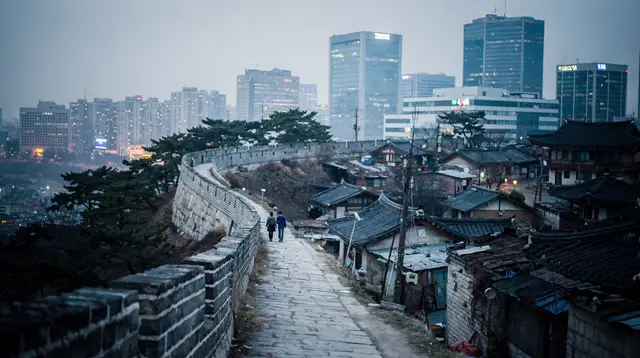
Hwaseong Fortress in Suwon is one of the most complete surviving fortifications from the Joseon Dynasty, and it has a distinction most Korean heritage sites don’t: it’s genuinely easy to reach from Seoul, sitting about 30 kilometers south of the capital and connected by a direct subway line with no transfers needed for most starting points in southern Seoul. That accessibility, combined with UNESCO World Heritage status since 1997, makes it one of the better half-day additions to a Seoul trip for travelers who want real history without a long transit commitment.
The fortress was built between 1794 and 1796 under King Jeongjo, who commissioned it partly as a display of filial devotion — the fortress town was meant to house the remains of his father, Crown Prince Sado, and partly as a genuinely advanced piece of military engineering for its era, incorporating design ideas that were unusually progressive for 18th-century Korea. What survives today, after damage during the Korean War and a substantial mid-20th-century restoration, is a nearly complete 5.7-kilometer circuit of walls, gates, watchtowers, and command posts that you can walk in a single outing.
Getting to Suwon from Seoul
Suwon Station is served directly by Seoul’s Line 1 subway, making it one of the simplest day trips on this list logistically — no bus transfer, no private car needed, just a straightforward subway ride of roughly 30-50 minutes depending on your starting station in Seoul. From Suwon Station, the fortress area is a short taxi ride or a 15-20 minute walk, and local buses also loop through the fortress district.
For travelers who’d rather not manage the walk between fortress sections or want the context of a guide, a Suwon Hwaseong Fortress day trip from Seoul covers transport and a guided walk of the key sections in either a half-day or full-day format, useful if you’re deciding how much time to give the site before committing.
If you haven’t yet worked out how the subway and a T-money card fit together, our Seoul metro and T-money guide covers it before you go. And if you’re still choosing a base, where to stay in Seoul is worth a look, since a hotel near a Line 1 station makes this trip simpler.
Walking the wall: what to expect
The full 5.7km circuit is walkable in about 2-3 hours at a relaxed pace, though most visitors don’t walk the entire loop — the highlights cluster around a few sections that cover the most interesting architecture without requiring the full circuit. Janganmun, the fortress’s main northern gate, is the largest and most photogenic of the four main gates, with a distinctive half-moon barbican in front of it. Hwaseong Haenggung, the temporary palace inside the fortress walls, is where King Jeongjo stayed during his visits and now hosts a small changing-of-the-guard ceremony reenactment on weekends.
Seojangdae, the western command post, sits atop a hill and offers the best elevated view over both the fortress and the modern city of Suwon spreading out below — worth the climb even if you don’t walk much of the rest of the wall. The section of wall between Hwaseomun (west gate) and the northern gate is one of the more scenic and less crowded stretches, running along a ridge with good views and fewer tour groups than the areas immediately around Janganmun.
A small tourist train (Hwaseong-eolongchacha) loops around part of the fortress perimeter for visitors who want to cover ground without walking the whole wall, useful for families with young kids or anyone visiting in summer heat.
Hwaseong Haenggung and the changing of the guard
Hwaseong Haenggung, the largest surviving detached palace of its kind in Korea, sits within the fortress walls and functioned as King Jeongjo’s temporary residence during his ceremonial visits to Suwon. It was almost entirely destroyed during the Japanese colonial period and rebuilt through restoration efforts starting in the 1990s, so what you see today is a careful reconstruction rather than a fully original structure — worth knowing if you’re comparing it to older, less-restored sites elsewhere in Korea.
On weekends, a martial arts and changing-of-the-guard performance takes place near the palace, drawing a moderate crowd but rarely feeling as staged or overcrowded as similar ceremonies at Seoul’s central palaces. Check current performance schedules before planning your visit around it, since timing shifts seasonally.
The Korean Folk Village: a common pairing
Many day trips from Seoul bundle Hwaseong Fortress with the Korean Folk Village, a living-history museum a short drive from Suwon that reconstructs a traditional Joseon-era village with craftspeople, period architecture, and seasonal performances. The two sites complement each other well — Hwaseong shows the era’s military and civic engineering, the Folk Village shows its everyday domestic and craft life — and a combined visit is a common and sensible way to spend a full day rather than splitting Suwon and the Folk Village across separate trips.
A Suwon Hwaseong Fortress and Korean Folk Village tour packages both sites with transport in a single day, which is generally more efficient than arranging the connection between them independently. For travelers who also want a modern retail stop, some operators add Starfield Library, Suwon’s striking multi-story bookshelf installation inside a shopping mall — a Suwon Hwaseong, Folk Village, and Starfield Library tour covers all three in one itinerary if you want the contrast between 18th-century fortress and contemporary retail architecture in a single day.
Suwon fits neatly into a wider plan for the region. The Seoul day trips week itinerary shows where a fortress day sits alongside other excursions, and the Seoul 5-day itinerary is a good model if you only have room for one trip out of the city. Other half-day escapes from the capital include Ganghwa Island and Paju, Heyri and Imjingak, each with a very different character from a walled Joseon town.
Suwon beyond the fortress
Suwon is a genuine city in its own right, not just a fortress backdrop — it’s Gyeonggi Province’s provincial capital, with a population in the millions and a modern downtown that sits just outside the fortress walls. Suwon is also well known within Korea for a specific culinary specialty: galbi (grilled short ribs), with a style of preparation the city is particularly associated with. If you have time beyond the fortress walk, a sit-down galbi meal in one of the long-established restaurants near the fortress area is a worthwhile detour from a pure sightseeing itinerary.
The city’s Paldalmun traditional market, near the fortress’s southern gate, is a working local market rather than a tourist-oriented one, and it’s a reasonable stop for street food and a look at daily commerce that feels distinct from central Seoul’s more visitor-heavy markets.
Food is part of the day too. For more on eating well on a budget, see the Seoul street food guide and the Seoul night markets article, which put Paldalmun’s casual stalls in context.
Half day or full day: what changes
| Half day (3-4 hrs) | Full day | |
|---|---|---|
| Covers | Janganmun, Hwaseong Haenggung, Seojangdae, one wall section | All of the above plus Korean Folk Village or a galbi meal |
| Best for | Travelers slotting Suwon into a busier Seoul week | Dedicated history/culture day with no rush |
| Pace | Brisk but not rushed | Relaxed, room for the market or a sit-down meal |
| Tour option | Suwon Hwaseong Fortress day trip | Fortress + Korean Folk Village tour |
If you’re deciding the night before, default to the half-day plan — it’s easy to extend on the ground if you’re enjoying the walk, but hard to compress a full-day itinerary back down if you’re running short on time or energy partway through.
How much time to budget
A half day (3-4 hours including transit) covers the fortress highlights — Janganmun, Hwaseong Haenggung, Seojangdae, and a section of the wall — comfortably. A full day allows you to add the Korean Folk Village or a proper meal and market visit without rushing either. Given the ease of the subway connection, Suwon also works as a relatively low-effort half-day add-on to a Seoul itinerary that’s otherwise focused on the city center, unlike destinations that require a full day purely for transport.
Best time to visit
Spring and autumn are the most comfortable seasons for walking an exposed fortress wall with limited shade across long stretches — summer heat makes the full circuit genuinely uncomfortable by early afternoon, and the site offers little shelter from direct sun. Winter is workable and considerably less crowded, though some sections can be slippery if there’s been recent snow or ice. See our Seoul autumn foliage guide for how the wider Gyeonggi region’s color season compares to central Seoul’s timing.
Palace fans should also read Gyeongbokgung vs Changdeokgung vs Deoksugung to compare how Seoul’s royal sites differ from Jeongjo’s fortress, and the hanbok rental and free palace entry guide if dressing the part appeals. Planning the season? The best time to visit Seoul and the Seoul cherry blossom guide help you pick your weeks, while the jangma rainy season guide explains why summer is the weakest window for exposed walls.
Why Hwaseong is considered engineering ahead of its time
What separates Hwaseong from many other Korean fortress remains is the level of documentation and engineering ambition behind its construction. King Jeongjo’s court compiled the Hwaseong Seongyeok Uigwe, a detailed construction record covering materials, labor, costs, and building techniques used across the roughly two-and-a-half-year build. That record proved invaluable centuries later: when parts of the fortress were damaged during the Korean War, restorers were able to rebuild damaged sections with a level of historical accuracy rarely possible at other Korean heritage sites, which is part of why UNESCO specifically cited the fortress’s combination of authentic and accurately restored elements when granting World Heritage status.
The construction itself incorporated cranes and pulley systems (including a device called the geojunggi, an early crane mechanism credited partly to the reformist scholar Jeong Yak-yong) that were considered innovative for the period, letting builders move stone blocks more efficiently than traditional methods and complete the fortress faster than originally projected. Signage around the site references this engineering history in more detail, and it’s worth reading rather than skipping past if you’re at all interested in pre-industrial construction methods — it’s a more technically interesting story than the fortress’s calm, park-like grounds might suggest at first glance.
Food near the fortress
Suwon galbi deserves a specific mention beyond a passing reference: the city has a genuine culinary identity built around grilled short ribs prepared in a style distinct from Seoul’s more generic barbecue restaurants, typically using a specific cut and seasoning approach that long-established local restaurants have built reputations around over decades. Several well-known galbi restaurants cluster within a short distance of the fortress area, and a sit-down meal here is a reasonable and locally authentic way to break up a half-day or full-day visit, rather than defaulting to convenience-store food near the subway station.
Paldalmun traditional market, near the fortress’s southern gate, offers a cheaper and more casual alternative — street food stalls, produce vendors, and small eateries serving a cross-section of what Suwon residents actually eat day to day, with far fewer tourists than markets closer to central Seoul like Gwangjang Market.
Practical tips for visiting
Wear real walking shoes rather than sandals — sections of the wall path are uneven stone, and the climb to Seojangdae involves genuine stairs and incline. Bring water and sun protection in warmer months, since long stretches of the wall offer no shade. If you’re visiting independently rather than on a guided tour, download an offline map or use Naver Map rather than Google Maps before you arrive, since the fortress area’s gates and access points aren’t always intuitively laid out from a first-time visitor’s perspective.
Combination tickets covering the fortress grounds, Hwaseong Haenggung, and sometimes a regional museum are usually the better value over paying separate admission at each gate, and they’re sold at ticket booths near the main entrances rather than requiring advance online purchase, which makes independent, unplanned visits easy to pull off.
Restrooms and water refill points are spaced along the wall circuit near the main gates, but they thin out on the quieter stretches between Hwaseomun and the northern gate, so top up water before setting off on that section specifically rather than assuming facilities will appear when needed. Cash is still useful at some smaller food stalls near the fortress and Paldalmun market, even though card payment is standard almost everywhere else in Korea, so keep a small amount on hand for that specific stretch of the visit.
Before you set out, the 25 things to know before visiting Seoul and the Korean etiquette mistakes article are quick reads that apply on any day trip, and the Seoul budget costs guide helps you judge what a day out like this really adds up to.
A realistic first-timer’s route
If you’re visiting independently and want a sensible order rather than wandering, start at Janganmun (the main gate) since it’s the most direct walk from the taxi or bus drop near Suwon Station, then head to Hwaseong Haenggung to catch the changing-of-the-guard performance if your visit falls on a weekend, and finish with the climb to Seojangdae for the best overview before heading back down. This sequence keeps the steepest walking — the climb to Seojangdae — for when you’re already warmed up rather than tackling it cold, and it times naturally with the weekend performance schedule if that’s part of the draw. Budget roughly an hour at each of the three stops if you’re not rushing, plus transit time between them.
Frequently asked questions about Suwon and Hwaseong Fortress
How long does it take to walk the entire Hwaseong Fortress wall?
The full 5.7km circuit takes roughly 2-3 hours at a relaxed walking pace with stops. Most visitors don’t complete the entire loop, instead focusing on the highlight sections around Janganmun, Hwaseong Haenggung, and Seojangdae.
Do I need a guide to visit Hwaseong Fortress?
No, the site is well signposted and walkable independently, especially with the subway connection making access simple. A guide adds historical context that isn’t always covered on-site signage, which is the main value of a guided day trip over an independent visit.
Is Hwaseong Fortress good for visitors with limited mobility?
Parts of the site are, particularly Hwaseong Haenggung’s palace grounds and the flatter sections near Janganmun, but the full wall circuit involves uneven terrain, stairs, and a genuine hill climb at Seojangdae. The tourist train is a reasonable alternative for covering more ground with less physical effort.
Can I combine Suwon with other Gyeonggi day trips?
Suwon pairs most naturally with the Korean Folk Village given their proximity. Combining it with more distant destinations like Everland or Nami Island in a single day is possible geographically but tends to feel rushed given the distances involved between them.
Is there an entrance fee for Hwaseong Fortress?
Yes, a modest admission fee applies for the fortress grounds and Hwaseong Haenggung palace, with combination tickets sometimes available. Prices are low relative to Seoul’s palace admission fees and rarely a significant factor in trip planning.
What’s the best single viewpoint at Hwaseong Fortress?
Seojangdae, the western command post on high ground, offers the best combined view of the fortress walls and the modern city below, and it’s a common recommendation for a single stop if your time is very limited.
Is Suwon worth visiting without seeing the fortress?
Less so as a standalone case — most travelers come specifically for Hwaseong Fortress, and without it, Suwon functions more as a regional city than a distinct attraction. The fortress is genuinely the reason to make the trip.
How does Hwaseong Fortress compare to Seoul’s city walls?
Both are Joseon-era fortifications, but Hwaseong is more architecturally intact and compact, making it easier to appreciate as a complete structure in a single visit, while Seoul’s city wall is longer, more fragmented by the modern city built around and through it, and typically walked in shorter individual sections rather than as one continuous loop.
Is Hwaseong Fortress crowded?
Less so than Seoul’s central palaces, generally. Weekends see more visitors, particularly around the Hwaseong Haenggung performance times, but even then the site’s scale means crowds spread out rather than concentrating the way they can at a single palace courtyard.
What’s the closest train station to Hwaseong Fortress?
Suwon Station, on Seoul’s Line 1, is the main arrival point, followed by a short taxi ride, bus, or 15-20 minute walk to the fortress area. Some visitors instead use Hwaseo Station, slightly closer to the western gate, though it involves an additional transfer for most Seoul departures.