An island with an outsized role in Korean history
Ganghwa Island, connected to the mainland by bridge within Incheon’s administrative area, is easy to underestimate on a map — it looks like a modest island off Korea’s west coast, not obviously more significant than dozens of others. In practice, it has played a disproportionately large role in Korean history: a refuge for the Goryeo Dynasty court during the 13th-century Mongol invasions, the site of the country’s oldest known megalithic tombs, a strategic defensive position during the 19th-century French and American incursions, and, in the modern era, the location where Korea’s 1876 treaty with Japan (opening the country to Japanese trade under unequal terms) was signed.
| Where | Incheon, connected to the mainland by bridge |
| Cost | Free to low-cost site entry; guided tour for easiest access |
| Time needed | A full day for dolmens, a fortress, and the temple |
| Getting there | Car, private tour, or limited-frequency public bus |
| Best time | Spring and autumn for comfortable walking |
That density of history, spread across a genuinely large island, is both the appeal and the practical challenge of visiting — this isn’t a single compact site but a scattering of dolmens, fortresses, temples, and historical markers across considerable distance, better suited to a car or organized tour than an attempt to string together public buses.
The Ganghwa dolmens: Korea’s oldest structures
The Ganghwa Dolmen Site, a UNESCO World Heritage listing since 2000 (grouped together with dolmen sites at Gochang and Hwasun elsewhere in Korea), contains some of the largest and best-preserved dolmens — megalithic tomb structures built from massive capstones set on supporting stones — anywhere in the world. Korea has an unusually high concentration of dolmens globally, and Ganghwa’s examples, particularly the large table-style dolmen at Bugeun-ri, are striking simply for their scale: stone slabs weighing many tons, moved and positioned by Bronze Age communities using methods that remain a subject of ongoing archaeological study.
Unlike more built-up heritage sites, the dolmens sit in relatively open, unadorned settings — a field, a low rise of land — which lends them a genuinely different atmosphere from a palace or fortress visit. There’s little in the way of interpretive infrastructure beyond basic signage, and part of the appeal for many visitors is exactly that lack of polish: standing next to a several-thousand-year-old burial monument with minimal tourist infrastructure around it.
Fortresses and the 19th-century incursions
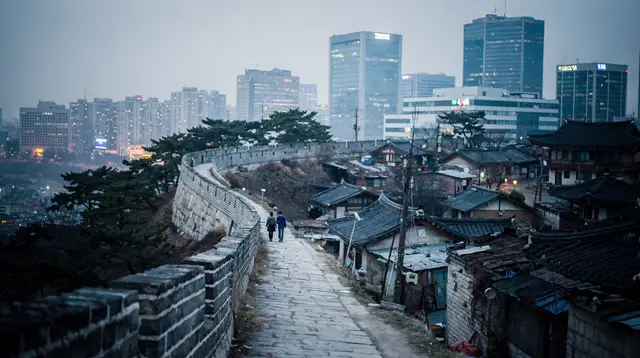
Ganghwa’s coastal fortresses — including Gwangseongbo and Chojijin — date largely from the Joseon Dynasty’s coastal defense efforts and saw real combat during the French Campaign against Korea in 1866 and the United States expedition to Korea in 1871, both of which involved Western naval forces attempting to force Korea open to trade through military pressure, and both of which Korean defenders resisted, at real cost, from these fortifications. The battle sites are marked with monuments and preserved fortress walls, and the setting — coastal, exposed to the sea, with clear sightlines that explain the strategic logic of the fortress placements — helps make the history tangible in a way that a museum display alone wouldn’t.
These sites see meaningfully fewer visitors than Seoul’s central historical attractions, which for many travelers is part of the appeal: a chance to walk genuinely historic ground without competing for space or photo angles.
Jeondeungsa Temple
Jeondeungsa, one of Korea’s oldest Buddhist temples, sits within a fortress wall on Ganghwa and combines temple architecture with the added interest of the surrounding fortification. The temple complex includes buildings dating across several centuries of renovation and rebuilding, and its setting within a forested hillside gives it a more secluded atmosphere than temples closer to central Seoul. It’s a reasonable stop for travelers interested in Korean Buddhist architecture who want a quieter alternative to more heavily visited temple sites.
Getting to Ganghwa Island
Ganghwa is connected to the mainland by bridge, making it accessible by car or bus from Incheon or Seoul, though there’s no direct subway connection given the distance and the island’s more rural character. Public bus service exists but requires transfers and offers limited frequency to reach the more spread-out historical sites, making it a genuinely inconvenient option for travelers without a car who want to see more than one or two sites in a day.
A private UNESCO World Heritage tour of Ganghwa Island from Seoul is the most practical option for most visitors, covering transport and a guided route between the dolmens, fortresses, and temple without the logistical difficulty of coordinating rural bus schedules or driving yourself on unfamiliar roads.
How much time to budget
A full day is realistic if you want to properly cover the dolmen site, at least one fortress, and Jeondeungsa Temple, given the driving distances between them on an island considerably larger than its position on a map might suggest. A half day is workable if you narrow your visit to just the dolmens and one additional site, but trying to compress the island’s full range of historical stops into a half day generally means rushing past sites that reward a slower, more attentive visit.
Ganghwa compared to other Incheon and Gyeonggi day trips
Ganghwa offers a genuinely different experience from Incheon’s Chinatown and Songdo, trading urban density and food culture for open landscape and ancient history, and it’s a quieter, less crowded alternative to Gyeonggi’s more heavily marketed day trips like Nami Island or Everland. Travelers specifically drawn to lesser-visited historical sites and open coastal scenery over polished tourist infrastructure will get the most out of Ganghwa; those looking for a livelier, more photo-driven day trip are likely better served by Gyeonggi’s more popular options.
If the urban side of Incheon appeals more than the countryside, an Incheon day built around a rail bike ride and the Chinatown district makes a lighter alternative, and it can sit on a separate day from Ganghwa. For a wider look at how day trips fit together, the Seoul day trips week itinerary shows where a quiet history day like this one slots in, and Suwon’s Hwaseong Fortress is the closest comparison if fortress history is what you’re after.
Local food and produce
Ganghwa is known within Korea for a few specific agricultural products, most notably a variety of turnip (Ganghwa mu) and ginseng grown in the island’s soil, along with seafood from the surrounding coastal waters. Small local restaurants near the main historical sites serve straightforward Korean meals rather than a tourist-oriented dining scene, and the pace of eating here tends to match the island’s generally unhurried character — a good complement to a day built around walking between historical sites rather than shopping or nightlife.
The Goryeo Dynasty’s mountain fortress capital
Less visited than the dolmens or coastal fortresses but historically significant in its own right, Ganghwa served as a temporary royal capital during the 13th century when the Goryeo Dynasty court relocated here to resist Mongol invasions of the Korean peninsula, betting that the tidal straits separating the island from the mainland would hinder the Mongols’ cavalry-based military — a bet that largely paid off, since the Mongols never successfully invaded the island itself despite decades of continued warfare on the mainland.
Remnants of the fortifications and palace structures from this period are scattered across the island, generally less complete and less visually dramatic than the dolmens or the 19th-century coastal fortresses, but worth knowing about for the layer of history they add: a period when Ganghwa was, briefly, the functional seat of Korean royal power.
This episode also explains part of why Ganghwa has such an unusually dense concentration of historically significant sites for an island of its size — centuries of use as both a strategic refuge and a frontline defensive position against multiple different foreign incursions left physical traces that a less contested location simply wouldn’t have accumulated.
Fitting Ganghwa into a wider Seoul trip
Ganghwa works best as a counterweight to Seoul’s busier days. After a stretch of palaces and markets, a day among open fields and coastal walls resets the pace. If you have already seen the city’s royal sites, the Gyeongbokgung and Jongno area gives the urban side of the same story, while Seoul in three days and Seoul in five days show where a day away from the capital can fit without crowding the schedule. Travelers who like the idea of a quiet, history-first excursion may also enjoy the Seoul and Gangwon side trip, and it helps to read how to get around with the metro and T-money before you leave the city, since the first leg toward the island often starts on public transport.
Navigation is the other thing to sort out in advance. Because Google Maps doesn’t work properly in Korea, download a Korean map app before you head to a rural area like this one, and check the best time to visit Seoul so your walking days land in comfortable weather rather than in the jangma rainy season.
Practical tips for visiting
Because sites are spread across the island with genuine driving distances between them, plan a rough route in advance rather than expecting to improvise site-to-site the way you might in a compact walkable district. Comfortable walking shoes matter here too — several of the fortress and dolmen sites involve walking across open or uneven ground rather than paved paths. Cell signal and English-language signage are more inconsistent than in central Seoul, another point in favor of a guided tour over a fully independent visit if you’re not comfortable navigating with limited on-site support.
Bring cash for smaller local restaurants and produce stalls, particularly outside the immediate vicinity of the more visited sites, where card acceptance can be less consistent than in central Seoul or Incheon proper.
A suggested route if you’re driving yourself
Ganghwa rewards a rough plan more than most day trips near Seoul, given the genuine distances between sites. A workable loop starts at the Bugeun-ri dolmen site in the morning, when light is best for photographs and before the day’s heat sets in. From there, head to Gwangseongbo Fortress on the island’s eastern coast for the mid-morning stretch, where the sightlines out over the water make the 19th-century battle history easiest to visualize.
Break for lunch at a small local restaurant near the fortress rather than driving back toward the dolmens, since Ganghwa’s eateries are scattered rather than clustered. Spend the afternoon at Jeondeungsa Temple, saving it for last since its forested hillside setting suits the softer late-afternoon light better than the open dolmen field does at midday. This order minimizes backtracking across the island and matches each site’s best conditions to the time of day you’ll actually be there.
How Ganghwa compares as a border-region day trip
Travelers weighing Ganghwa against a dedicated border-history day should know the two aren’t really substitutes for each other. The DMZ and JSA focus specifically on the 1953 armistice line and the ongoing Korean War division, with restricted-access sites and advance booking requirements.
Ganghwa’s border-adjacent history is older and less formal — 19th-century naval battles rather than Cold War infrastructure — and its northern coastal viewpoints toward North Korea require no booking or security clearance at all. If your interest is specifically the DMZ’s modern military history, that’s the better dedicated trip; if you want a broader sweep of Korean history that happens to include a border-region layer, Ganghwa covers more ground in a single, less restricted day.
Frequently asked questions about Ganghwa Island
How do I get to Ganghwa Island without a car?
Public buses connect the island to Incheon and parts of Seoul, but service to the more spread-out historical sites is limited and requires transfers. A private tour or rental car is the more practical option for covering multiple sites in a single day.
Are the Ganghwa dolmens similar to Stonehenge?
They’re a different type of megalithic structure — table-style dolmens built as burial monuments rather than a stone circle — but they share the general category of prehistoric megalithic architecture and a similar sense of scale and mystery around how Bronze Age communities moved and positioned such large stones.
Is Ganghwa Island good for a full day or just a few hours?
A full day is the more realistic way to see the dolmens, a fortress, and the temple properly, given the driving distances between sites on an island larger than it appears on a map. A shorter visit works if you narrow your focus to just one or two sites.
Is Ganghwa Island crowded?
No, it’s one of the quieter historical day trips near Seoul, seeing considerably fewer visitors than Nami Island, Everland, or the DMZ. This is part of its appeal for travelers seeking a less touristy alternative.
What’s the most important single site to see on Ganghwa Island if I only have a few hours?
The Bugeun-ri dolmen site is the strongest single stop for its combination of historical significance and visual scale, and it’s usually the anchor point around which shorter visits are built.
Does Ganghwa Island have accommodation for an overnight stay?
Yes, though options are more limited and rural in character compared to central Seoul or Incheon. Most visitors treat Ganghwa as a day trip rather than an overnight destination, given its manageable distance from Seoul and Incheon.
Is Ganghwa Island suitable for visitors with limited mobility?
Some sites, particularly the more remote fortress and dolmen locations, involve uneven ground and walking between parking areas and the actual monuments. It’s less accessible than a flat, paved urban attraction, and travelers with mobility concerns should research specific site conditions in advance.
How does Ganghwa Island’s history connect to the DMZ and Korea’s division?
Ganghwa sits near the mouth of the Han River close to the North Korean border, and its coastal fortresses reflect a much older history of defending against Western naval incursions in the 19th century rather than the Korean War division itself, though the island’s proximity to the North does add a layer of border-region context similar in spirit, if not in specifics, to a visit to the DMZ.
Can I see North Korea from Ganghwa Island?
In certain spots along the island’s northern coast, on clear days, you can see across the water toward North Korean territory, similar in concept to the viewpoints at the DMZ’s Dora Observatory but without the same level of formal infrastructure or restricted access. This isn’t the primary reason most visitors come to Ganghwa, but it’s a notable detail for travelers interested in the border region generally.
Is Ganghwa Island a good add-on to a Seoul itinerary focused on history?
Yes, particularly for travelers who’ve already covered Seoul’s central palaces and want a deeper, less crowded historical experience spanning a wider range of Korean eras — from Bronze Age dolmens through the Goryeo Dynasty to 19th-century conflicts with Western powers — in a single day trip.
Can I combine Ganghwa Island with Incheon’s Chinatown in one day?
It’s possible given their shared Incheon location, but the honest answer is that both deserve real time — Incheon Chinatown and Songdo is a compact, walkable urban district while Ganghwa requires driving between spread-out sites, so combining them makes for a long day that shortchanges one or the other. Treating them as separate day trips gives each its due.